Question
Derive an Ideal gas equation. Mention the terms involved in it. Also write how it is utilised to obtain combined gas
where,
$P =$ Pressure of gas,
$V=$ Volume of gas,
$n =$ number of moles of gas,
$R=$ Gas constant,
$T$ = Absolute temperature of gas.
This is the ideal gas equation or equation of state.
[Note: In the ideal gas equation, $R$ is called gas constant or universal gas constant, whose value is same for all the gases. In this equation, if three variables are known, fourth can be calculated. The equation describes the state of an ideal gas. Hence, it is also called as equation of state.]
The ideal gas equation is written as $P V=n R T \quad \ldots(1)$ On rearranging equation (1), we get,
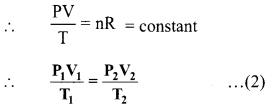
The ideal gas equation used in this form is called combined gas law.
Generate a complete, print-ready paper with questions like this in minutes — across 16+ boards, with answer keys.
| Column A | Column B | ||
| i. | Castner-Kellner cell | a. | Na2CO |
| ii. | Slaked lime | b. | CaCO3 |
| iii. | Solvay process | c. | NaOH |
| iv. | Limestone | d. | Ca(OH)2 |