Question
Derive dimension and SI unit of magnetic flux.

Answer

Magnetic Flux : Magnetic flux linked with a surface of area A placed in a magnetic field B is given by $\Phi_{B} = \vec{B}.\vec{A}$ i.e. $\Phi_{ B }= B \cdot A \cos \theta$, where $\theta=$ angle between $\overrightarrow{ B }$ and $\overrightarrow{ A }$.
Dimension of $\Phi_{B}=[B][A]$
(because $\cos\theta$ is dimensionless)
$\Rightarrow \quad\left[\Phi_{ B }\right]=\left[ MT ^{-2} A^{-1}\right]\left[ L ^2\right]$
$=[ML^{2}T^{-2}A^{-1}]$
S.I. Unit of Magnetic Flux :
$\Phi_{B}=BA\cos\theta$
⇒ S.I. Unit of $\Phi_{B}=S.I.$ Unit of $B \times S.I.$ Unit of A
$[\because \cos \theta$ has no unit $]$
$=(\frac{N}{Am}) \times m^{2}=NmA^{-1}$
Since $\quad Nm=J$
$\therefore \quad$ S.I. unit of $\Phi_B=J A^{-1}$
Although the S.I. unit of magnetic flux used in practice is weber denoted by Wb.

Need a full question paper?

Generate a complete, print-ready paper with questions like this in minutes — across 16+ boards, with answer keys.
Start Generating Free

Similar questions

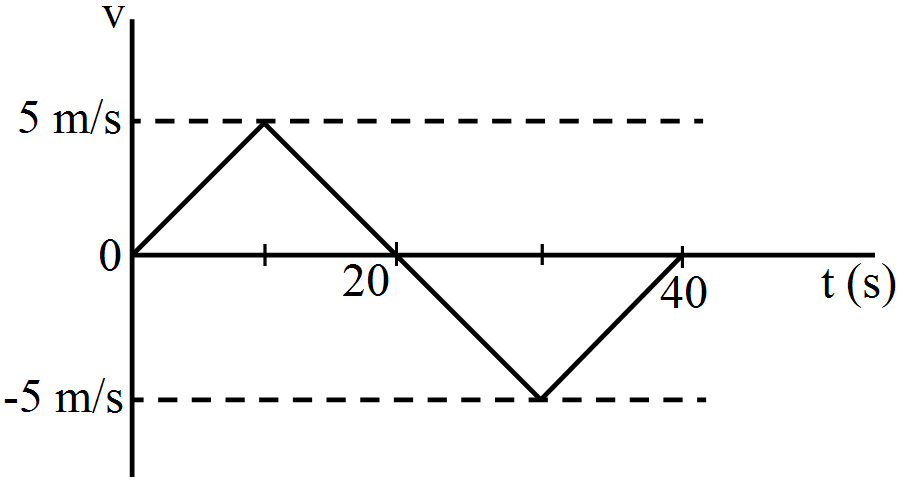
From the velocity-time plot shown in figure, find the distance travelled by the particle during the first 40 seconds. Also find the average velocity during this period.
Two towers on top of two hills are $40 \ km$ apart. The line joining them passes $50 m$ above a hill halfway between the towers. What is the longest wavelength of radio waves, which can be sent between the towers without appreciable diffraction effects?
A convex lens (n = 1.5) of focal length fa is immersed.
  1. In water n = 1.33 and.
  2. In carbon disulphide n = 1.6, how does the lens behave in the two cases?
Derive the equation for the force acting on two parallel current carrying wires.
Let $\overrightarrow{\text{A}}=5\vec{\text{i}}-4\vec{\text{j}}$ and $\overrightarrow{\text{B}}=-7.5\vec{\text{i}}+6\vec{\text{j}}.$
  1. Do we have $\overrightarrow{\text{B}}\text{k}\vec{\text{A}}?$
  2. Can we say $\frac{\overrightarrow{\text{B}}}{\overrightarrow{\text{A}}}=\text{k}?$
A hydrogen atom contains one proton and one electron. It may be assumed that the electron revolves in a circle of radius $0.53$ angstrom $(1$ angstrom $= 10^{-10}m$ and is abbreviated as $A)$ with the proton at the centre. The hydrogen atom is said to be in the ground state in this case. Find the magnitude of the electric force between the proton and the electron of a hydrogen atom in its ground state.
  1. Distinguish between ‘Analog’ and ‘Digital’ forms of communication.
  2. Explain briefly two commonly used applications of the ‘Internet’.
Write a short note on Gamma rays.
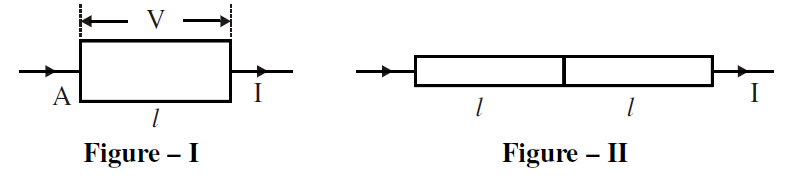
A metal rod of square cross-sectional area A having length l has current I flowing through it when a potential difference of V volt is applied across its ends (figure I). Now the rod is cut parallel to its length into two identical pieces and joined as shown in figure II. What potential difference must be maintained across the length 2l so that the current in the rod is still I?
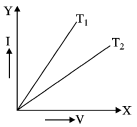
I-V graph at two different temperatures $T _1$ and $T _2$ for a metallic wire. Which temperature is greater and why? Image