Question
Derive integrated rate equation for first order reaction and also explain how than rate constant can be determine with help of graph.
Answer

$\rightarrow$ "First order reaction means that the rate reaction is proportional to the first power the concentration of the reactant $R.$ "
$\rightarrow$ For example, consider the following reaction
$R \rightarrow P$
$\rightarrow$ Rate of reaction for this reaction can be expressed as
Rate $=-\frac{ d [ R ]}{ dt }= k [ R ]$
 Or $\frac{ d [ R ]}{[ R ]}=- kdt$
\rightarrow Integrating this equation, we get
$\ln [R]=-k t+I .. ..Eq. (1)$
where, $I$ is the constant of integration and its value can be determined easily.
$\rightarrow$ When $t =0, R =[ R ]_0$, where $[ R ]_0$ is the initia concentration of the reactant.
$\rightarrow$ Therefore, equation $(1)$ can be written as
$\ln [R]_0=- k \times 0+ I$
$\ln [ R ]_0= I$
$\rightarrow$ Substituting the value of $I$ in equation $(1)$
$\ln [ R ]=- kt +\ln [ R ]_0 \ldots \ldots \text { Eq. (2) }$
$\rightarrow $ Rearranging this equation
$\ln \frac{[ R ]}{[ R ]_0}=- kt$
or $k =\frac{1}{ t } \ln \frac{[ R ]_0}{[ R ]} ....Eq. (3)$
$\rightarrow$ At time $t_1$ from equation $(1)$
$\ln [R]_1=-k t_1+\ln [R]_0 \ldots \ldots$ Eq. $(4)$
At time $t _2$
$\ln [R]_2=- kt _2+\ln [ R ]_0 \ldots \ldots$ Eq. $(5)$
where, $[ R ]_1$ and $[ R ]_2$ are the concentration the reactants at time $t_1$ and $t_2$ respectively.
$\rightarrow \rightarrow \rightarrow$ Subtracting Eq. $(5)$ from $(4)$
$\ln [ R ]_1-\ln [ R ]_2=- kt _1-\left(- kt _2\right)$
$\ln \frac{[ R ]_1}{[ R ]_2}= k \left( t _2- t _1\right)$
$k =\frac{1}{\left( t _2- t _1\right)} \ln \frac{[ R ]_1}{[ R ]_2} \ldots \ldots \text { Eq. (6) }$
$\rightarrow$ So, equation $(2)$ can also be written as
$\ln \frac{[ R ]}{[ R ]_0}=- kt$
Taking antilog of both the side
$[ R ]=[ R ]_0 e ^{- kt }.. ...$ Eq. $(7)$
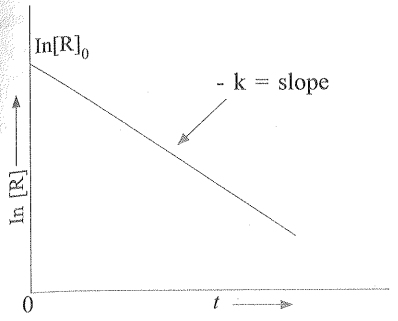
$\rightarrow$ Comparing equation $(2)$ with $y = mx + c,$ if we plot $\ln [R]$ against $t, $ we get a straight line with slope $=- k$ and intercept equal to $\ln [ R ]_0$
Image
$\rightarrow $ The first order rate equation $(3)$ can also be written in the form
$k =\frac{2.303}{ t } \log \frac{[ R ]_0}{[ R ]} \ldots \ldots \text { Eq. (8) }$
or $\log \frac{[ R ]_0}{[ R ]}=\frac{ kt }{2.303}$
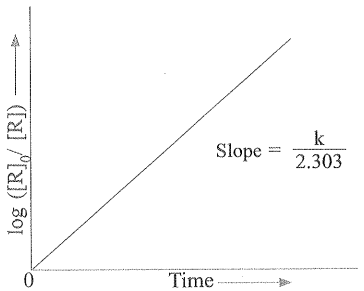
$\rightarrow$ If we plot a graph between $\log \frac{[R]_0}{[R]}$ vs $t,$ the slope $=\frac{ k }{2.303}$
Image

Need a full question paper?

Generate a complete, print-ready paper with questions like this in minutes — across 16+ boards, with answer keys.
Start Generating Free

Similar questions

Read the following text carefully and answer the questions that follow:
Many chemical and biological processes depend on osmosis, the selective passage of solvent molecules through the porous membrane from a dilute solution to a more concentrated one. The osmotic pressure $\pi$ depends on molar concentration of the solution ($\pi$ = CRT). If two solutions are of equal solute concentration and, hence, have the same osmotic pressure, they are said to be isotonic. If two solutions are of unequal osmotic pressures, the more concentrated solution is said to be hypertonic and the more diluted solution is described as hypotonic. Osmosis is the major mechanism, for transporting water upward in the plants. Transpiration is the leaves supports the transport mechanism of water. The osmotic pressure of seawater is about 30 atm; this is the pressure that must be applied to the seawater (separated from pure water using a semi-permeable membrane) to get drinking water.
i. What will happen if a plant cell kept in a hypertonic solution? 
ii. Blood cells are isotonic with 0.9% sodium chloride solution. What happens if we place blood cells in a solution containing in 1.2% sodium chloride solution?
iii. What happens when the external pressure applied becomes more than the osmotic pressure of solution?
Explain the preparation of haloalkanes from hydrocarbon.
Explain with equations, the nucleophilic addition reaction of aldehydes and ketones with alcohols. And also explain that why this reaction is carried out in the presence of dry hydrogen chloride ?
Write the reaction of phenol with the following :
(i) With $PCl _5$
(ii) With $NH _3$
(iii) Hinsberg reagent
(iv) Hydrogen.
The mole fraction of helium in a saturated solution at $20^\circ C$ is $1.2 g 10-6.$ Find the pressure of helium above the solution. Given Henry's constant at $20^\circ C$ is $144.97\ k\ bar. (2)$
Explain the addition of HX and halogens to alkenes.
Explain magnetic property of coordination compound.
What is depression of Freezing point ? What is molal depression constant $(K_f)$ ? Derive it's formula of finding molar mass of solute.
Write down the preparation of alkyl halides from alcohols.