Question
Derive integrated rate equation for zero order reaction and also explain how the rate constant can be determine with help of graph.
Answer

$\rightarrow$ "Zero order reaction means that the rate of the reaction is proportional to zero power of the concentration of reactants."
$\rightarrow$ Consider the reaction.
$R \rightarrow P$
$\rightarrow$ Rate of reaction for this reaction can be expressed as
Rate $=-\frac{ d [ R ]}{ dt }= k [ R ]^0$
$\rightarrow$ As any quantity raised to power zero is units.
Rate $=-\frac{ d [ R ]}{ dt }= k \text { X I }$
$\rightarrow$ Thus, the rate of zero order reaction is independent from concentration of reactants.
$d [ R ]=- k\ dt$
$\rightarrow$ Integrating both sides
$[ R ]=- kt + I ...Eq. (1)$
Where, $I$ is the constant of integration
$\rightarrow$ At $t=0$, the concentration of the reactant
$R=[ R ]_0$, where $[ R ]_0$ is initial concentration of the reactant.
$\rightarrow$ Substituting in equation $(1)$
${[ R ]_0=- kx 0+ I }$
${[ R ]_0= I }$
$\rightarrow$ Substituting the value of $I$ in the equation $(1)$
$[ R ]=- kt +[ R ]_0 ......Eq. (2)$
$\rightarrow$ Further simplifying equation $(2)$
$k =\frac{[ R ]_0-[ R ]}{ t } ...... Eq. (3)$
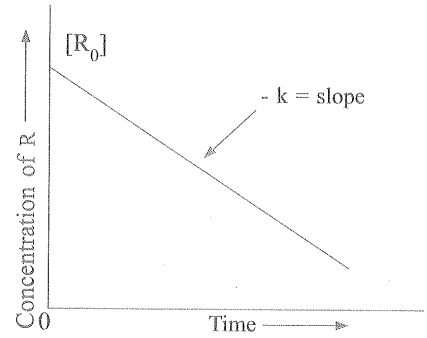
$\rightarrow$ Comparing equation $(2)$ with equation of straight line, $y=m x+c$, if we plot $[R]$ against $t$ , we get a straight line with slope $=- k$ and intercept equal to $[ R ]_0$
Image

Need a full question paper?

Generate a complete, print-ready paper with questions like this in minutes — across 16+ boards, with answer keys.

Start Generating Free

Similar questions

Do the following conversions in not more than two steps:
  1. Benzoic acid to benzaldehyde.
  2. Ethylbenzene to Benzoic acid.
  3. Propanone to Propene.
On the basis of the following data, explain why $Co -(III)$ is not stable in aqueous solution?
$Co^{3+}+e^{-} \rightarrow Co^2+, E^o=+1.82 V$
$2 H_2 O \rightarrow O_2+4 H^{+}+4 e^{-}, E^o=1.23 V$
Explain the following items:
Biocatalysts.
Define the following terms:
  1. Tranquilizer.
  2. Anionic detergent.
  3. Disinfectant.
The electrical resistance of a column of $0.05M$ NaOH solution of diameter $1 cm$ and length $50 cm$ is $5.55 x 10^3$ ohm. Calculate its resistivity, conductivity and molar conductivity.
Calculate the standard cell potential of the galvanic cell in which the following reaction takes place:
$\text{2 Cr(s)}+3\text{ Cd}^{2+}\text{(aq.)}\rightarrow2\text{Cr}^{3+}\text{(aq.)}+3\text{ Cd(s)}$
Also calculate the $\Delta_{\text{r}}\text{G}^{\ominus}$ value of the reaction.
$(\text{Given: }\text{E}^{\ominus}_{\text{ }\text{ }\text{ }\text{ Cr}^{3+/}/\text{Cr}}=+0.74\text{V};\text{E}^{\ominus}_{\text{ }\text{ }\text{ }\text{ }\text{Cd}^{2+}\text{/Cd}}=-0.40\text{V and F = 96500 C mol}^{-1})$.
One half$-$cell in a voltaic cell is constructed from a silver wire dipped in silver nitrate solution of unknown concentration. The other half$-$cell consists of a zinc electrode in $1.0 \ M$ solution of $Zn(NO_3)_2.$ A voltage of $1.48 \ V$ is measured for this cell. Use this information to calculate the concentration of silver nitrate solution.
[ Given, $E_{\mathrm{Zn}^{2+} / \mathrm{Zn}}^{\circ}=-0.763 \mathrm{~V}$ and $E_{\mathrm{Ag}^{+} / \mathrm{Ag}}^{\circ}=+0.80 \mathrm{~V}$ ].
Give reasons for the following:
  1. Aniline does not undergo Friedal-Crafts reaction.
  2. $(CH_3)_2\ NH$ is more basic than $(CH_3)_3\ N$ in an aqueous solution.
  3. Primary amines have higher boiling point than tertiary amines.
Explain Crystal field splitting in tetrahedral complax.
Nalorphene $(C_{19}H_{21}NO_3)$, similar to morphine, is used to combat withdrawal symptoms in narcotic users. Dose of nalorphene generally given is $1.5$ mg. Calculate the mass of $1.5 – 10^{–3}$ m aqueous solution required for the above dose.