Question
Derive the equation for the torque acting on a current carrying loop placed at an angle $\theta$ with uniform magnetic field $(\vec{B})$.
Answer

Image
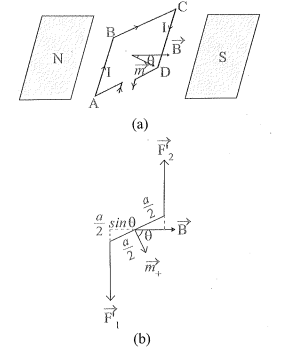
→As shown in the figure (a), the coil is placed in such a way that the magnetic field marks an angle $\theta$ with normal to the coil.
→The current passing through the coil is I. The length and width of the coil are $a$ and $b$ respectively.
→The force on the arm BC of the coil due to the current is $F _1= I a B \cos \theta$ and the force on the $\operatorname{arm} AD$ is $F _2= I a B \cos \theta$.
→Since, both these forces are equal, opposite and act along the axis of the coil, the resultant force and torque is zero.
→Similarly, the force acting perpendicular to the side AB and CD of the coil is $F _1{ }^{\prime}= F _2{ }^{\prime}= I b B$ respectively.
→Since, these two forces are equal in magnitude and opposite to each other the net force is zero. But they are non collinear, they form a couple, so a torque is exerted on the coil.
→From the figure (b) the torque acting on the coil.
$\begin{aligned}
\tau & =\left( F _1{ }^{\prime}\right) \frac{a}{2} \sin \theta+\left( F _2{ }^{\prime}\right)\left(\frac{a}{2}\right) \sin \theta \\
\therefore \tau & = I b B\left(\frac{a}{2}\right) \sin \theta+ I b B\left(\frac{a}{2}\right) \sin \theta \\
\therefore \quad \tau & =2 I b B \frac{a}{2} \sin \theta \\
\therefore \tau & = IB (a b) \sin \theta
\end{aligned}$
But $a b= A$ is the area of the rectangle.
$\therefore \tau= IAB \sin \theta$
→Vector form, $\vec{\tau}=I \vec{A} \times \vec{B}$
→But the magnetic dipole moment $\vec{m}= I \overrightarrow{ A }$
→The direction of the magnetic dipole moment is in the direction of area vector.
→Thus, torque acting on the coil $\vec{\tau}=\vec{m} \times \overrightarrow{ B } \ldots$
→If there are N turns in the coil then the torque is $\tau= NIAB \sin \theta$
Where, NIA $=m$ (magnetic moment)

Need a full question paper?

Generate a complete, print-ready paper with questions like this in minutes — across 16+ boards, with answer keys.

Start Generating Free

Similar questions

Show that it is not possible for a photon to be completely absorbed by a free electron.
A light ray is incident at an angle of 45° with the normal to a $\sqrt{2}\text{cm}$ thick plate $(\mu = 2.0)$. Find the shift in the path of the light as it emerges out from the plate.
Draw a schematic arrangement of the Geiger - Marsden experiment. How did the scattering of $\alpha-$ particles by a thin foil of gold provide an important way to determine an upper limit on the size of the nucleus? Explain briefly.
Two wires of different densities but same area of crosssection are soldered together at one end and are stretched to a tension T. The velocity of a transverse wave in the first wire is double of that in the second wire. Find the ratio of the density of the first wire to that of the second wire.
You are given a low resistance R1 a high resistance R2 and a moving coil galvanometer. Suggest how would you use these to have an instrument that will be able to measure?
  1. Current.
  2. Potential difference.
Mention the important considerations required while fabricating a p-n junction diode to be used as a Light Emitting Diode (LED). What should be the order of band gap of an LED if it is required to emit light in the visible range?
Consider Galileo's method of measuring the speed of light using two lanterns. To get an accuracy of about 10%, the time taken by the experimenter in closing or opening the shutter should be about one tenth of the time taken by the light in going from one experimenter to the other. Assume that it takes $\frac{1}{100}$ second for an experimenter to close or open the shutter. How far should the two experimenters be to get a 10% accuracy? What are the difficulties in having this separation?
When can a charge act as a source of electromagnetic wave? How are the directions of electric and magnetic field vectors, in an electromagnetic wave related to each other and to the direction of propagation of the wave?
Which physical quantity, if any, has the same value for waves belonging to the different parts of the electromagnetic spectrum?
Arrange the following electromagnetic waves in the order of their increasing wavelength:
  1. $\gamma- \text{rays}$.
  2. Microwaves.
  3. X-rays.
  4. Radio waves.
How are infra-red waves produced? What role does infra-red radiation play in (i) Maintaining the Earth’s warmth and (ii) Physical therapy?
There are two sources of light A and B. The wavelength of light emitted from A is from $8000\mathring{\text{A}}$ to $11000\mathring{\text{A}},$ while that from B is from $3000\mathring{\text{A}}$ to $6000\mathring{\text{A}}.$ The intensity of A is 4 times that of B. But when light of A falls on metal, photoelectrons are not emitted whereas light of B can eject photoelectrons from the same metal. Explain its reason.