Question
Derive the equation (formula) showing the relationship between electric field and electric potential.

Answer


Image
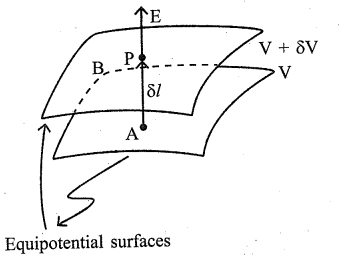
As shown in the fig., two equipotential surfaces A and B are very close to each other. Magnitudes of electric potentials on them are V and $V +\delta V$ respectively.
→Here, $\delta V$ is change in electric potential in the direction of electric field $\vec{E}$.
→Point $P$ is present on surface B. And the perpendicular distance from surface A to point P is $\delta l$.
→The amount of work done in taking a unit positive charge on the perpendicular line from surface B to surface A is equal to $|\vec{E}| \delta l$. This work is equal to the electric potential difference between surfaces $A$ and $B$, which is $V_A-V_B$.
$\begin{array}{l}
\therefore|\overrightarrow{ E }| \delta l=\Delta V = V _{ A }- V _{ B } \\
\therefore|\overrightarrow{ E }| \cdot \delta l= V -( V +\delta V ) \\
=-\delta V \\
\therefore \quad|\vec{E}|=-\frac{\delta V }{\delta l} \\
\end{array}$
→Here, $\delta V$ is negative, so taking $-\delta V$ in place of $\delta V$,
$|\overrightarrow{ E }|=\frac{\delta V }{\delta l}$    

Need a full question paper?

Generate a complete, print-ready paper with questions like this in minutes — across 16+ boards, with answer keys.
Start Generating Free

Similar questions

Compare the direction of the magnetic field inside a solenoid with that of the field there if the solenoid is replaced by its equivalent combination of north pole and south pole.
Draw a circuit diagram of n-p-n transistor amplifier in CE configuration. Under what condition does the transistor act as an amplifier?
Explain how does the polarized dielectric modify the original external field inside it ?
A Rowland ring of mean radius 15 cm has 3500 turns of wire wound on a ferromagnetic core of relative permeability 800. What is the magnetic field B in the core for a magnetising current of 1.2 A?
An $\alpha$–particle and a proton are moving in the plane of paper in a region where there is a uniform magnetic field directed normal to the plane of the paper. If the particles have equal linear momenta, what would be the ratio of the radii of their trajectories in the field?
A hydrogen atom contains one proton and one electron. It may be assumed that the electron revolves in a circle of radius 0.53 angstrom (1 angstrom = 10-10m and is abbreviated as A) with the proton at the centre. The hydrogen atom is said to be in the ground state in this case. Find the magnitude of the electric force between the proton and the electron of a hydrogen atom in its ground state.
What is the impact parameter? Explain the trajectory of $\alpha$-particle from it.
Find the maximum kinetic energy of the photoelectrons ejected when light of wavelength 350nm is incident on a cesium surface. Work function of cesium = 1.9eV
Suppose the energy liberated in the recombination of a hole-electron pair is converted into electromagnetic radiation. If the maximum wavelength emitted is 820nm, what is the band gap?
Can you add three unit vectors to get a unit vector? Does your answer change if two unit vectors are along the coordinate axes?