Question
Derive the equation required for finding the activation energy.

Answer

self

Need a full question paper?

Generate a complete, print-ready paper with questions like this in minutes — across 16+ boards, with answer keys.

Start Generating Free

Similar questions

Match the compounds given in Column I with the oxidation state of cobalt present in it (given in Column II) and assign the correct code.
 
Column I (Compound)
 
Column II (Oxidation state of Co)
$a.$
$[Co(NCS)(NH_3)_5](SO_3)$
$1.$
$+4$
$b.$
$[Co(NH_3)_4Cl_2]SO_4$
$2.$
$0$
$c.$
$Na_4[Co(S_2O_3)_3]$
$3.$
$+1$
$d.$
$[Co_2(CO)_8]$
$4.$
$+2$
 
 
$5.$
$+3$
Code:
  1. $A (1), B (2), C (4), D (5).$
  2. $A (4), B (3), C (2), D (1).$
  3. $A (5), B (1), C (4), D (2).$
  4. $A (4), B (1), C (2), D (3).$
A voltaic cell is set up at $25°C$ with the following half-cells $Al^{3+} (0.001M)$ and $Ni^{2+} (0.50M)$. Write an equation for the reaction that occurs when the cell generates an electric current and determine the cell potential. $(\text{Given:}\text{ E}^{\circ}_{\text{Ni}^{2+}/\text{Ni}}=-0.25\text{V,E}^{\circ}_{\text{Al}^{3+}/\text{Al}}=-1.66\text{V})$
Draw the structures of optical isomers of:
i. $\left[ Cr \left( C _2 O _4\right)_3\right]^{3-}$
ii. $\left[ PtCl _2( en )_2\right]^{2+}$
iii. $\left[ Cr \left( NH _3\right)_2 Cl _2( en )\right]^{+}$
Explain the relationship between $\Delta G$ and $E _{\text {cell }}^{\circ}$ with the help of an example.
Attempt any five of the following:
(a) Which sugar is present in milk?
(b) Why must vitamin C be supplied regularly in diet?
(c) What type of substance is phenylanine hydroxylate? Write its importance.
(d) Define denaturation of protein. What is the effect of denaturation on the structure of protein?
(e) Name the linkage connecting monosaccharide units in polysaccharides.
(f) How do you explain the presence of all six carbon atoms in glucose in a straight chain?
(g) Write the reactions showing the presence of following in the open structure of glucose:
i. a carbonyl group
ii. chain with six carbon atoms
The rate constant for the decomposition of $N_2O_5$ at various temperatures is given below:
$T/^\circ C$ $0$ $20$ $40$ $60$ $80$
$105 \times k/s-1$ $0.0787$ $1.70$ $25.7$ $178$ $2140$
Draw a graph between ln $k$ and $1/T$ and calculate the values of $A$ and $E_a$. Predict the rate constant at $30^\circ$ and $50^\circ C.$
  1. What are essential and non-essential amino acids? Give two examples of each.
  2. What are the two types of photosynthesis in green plants? Give the basic equations of photosynthesis.
  3. Mention the two products of glycolysis.
  1. Which poisonous gas is evolved when white phosphorus is heated with conc. $NaOH$ solution? Write the chemical equation.
  2. Write the formula of first noble gas compound prepared by $N$. Bartlett. What inspired $N$. Bartlett to prepare this compound?
  3. Fluorine is a stronger oxidizing agent than chlorine. Why?
  4. Write one use of chlorine gas.
  5. Complete the following equation: $CaF_2 + H_2SO_4 \xrightarrow{\text{ }\ \ \ \ \ \ \ \ \ \ \ \ }$

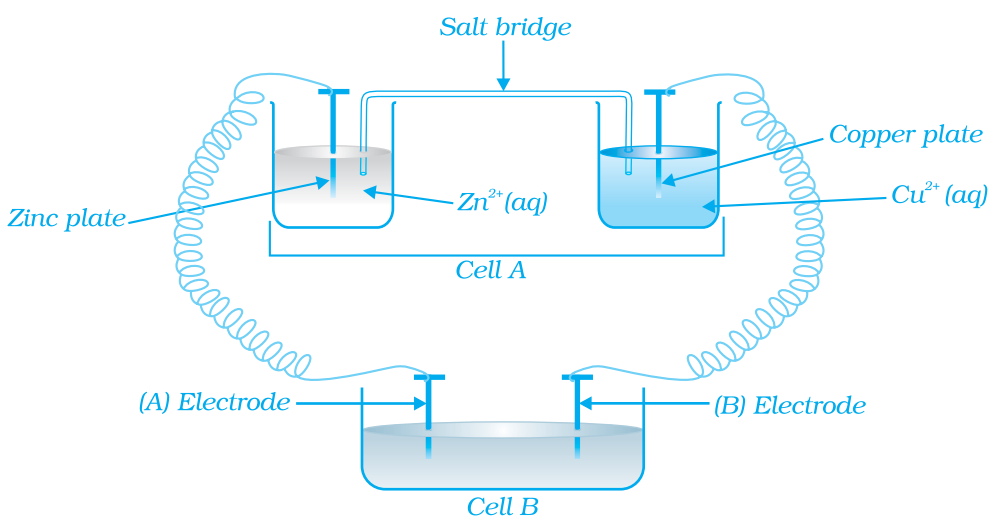
Consider the and answer the following questions.

i. Cell 'A' has $E_{\text {Cell }}=2 \mathrm{~V}$ and Cell 'B' has $E_{\text {Cell }}=1.1 \mathrm{~V}$ which of the two cells ' $A$ ' or ' $B$ ' will act as an electrolytic cell. Which electrode reactions will occur in this cell?
ii. If cell 'A' has $E_{C e l l}=0.5 \mathrm{~V}$ and cell 'B' has $E_{C e l l}=1.1 \mathrm{~V}$ then what will be the reactions at anode and cathode?
Discuss the different chemical properties of amines.