Question
Derive the expression for force per unit length between two long straight parallel current carrying conductors. Hence define one ampere.

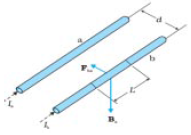
Figure shows two long parallel conductors a and b separated by a distance d and carrying (parallel) currents Ia and I b, respectively. The conductor ‘a’ produces, the same magnetic field Ba at all points along the conductor ‘b’. The right-hand rule tells us that the direction of this field is downwards (when the conductors are placed horizontally). Its magnitude is given by
$\text{B}_{\alpha} = \frac{\mu_\circ\text{I}_{\alpha}}{2\pi\text{d}}$
The conductor ‘b’ carrying a current I b will experience a sideways force due to the field Ba. The direction of this force is towards the conductor ‘a’. We label this force as Fba, the force on a segment L of ‘b’ due to ‘a’. The magnitude of this force is given by
$\int_{ba} = \text{I}_{b}\text{LB}_{a}$ $ = \frac{\mu_\circ\text{I}_{a}\text{I}_{b}}{2\pi\text{d}}\text{L}$
Let
$\int_{ba}$ represent the magnitude of the force $\text{F}_{ba}$ per unit length.$\int_{ba} = \frac{\mu_\circ\text{I}_{a}\text{I}_{b}}{2\pi\text{d}}$
One ampere: The ampere is the value of that steady current which, when maintained in each of the two very long, straight, parallel conductors of negligible cross-section, and placed one metre apart in vacuum, would produce on each of these conductors a force equal to 2 × 10⁻⁷ newton per metre of their length.
Generate a complete, print-ready paper with questions like this in minutes — across 16+ boards, with answer keys.