Question
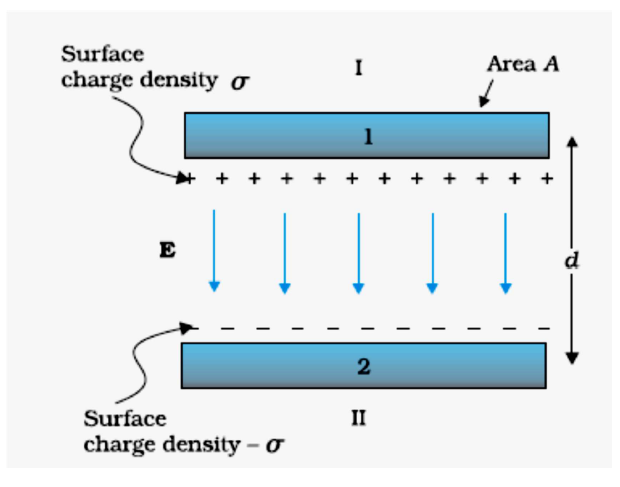
  1. Derive the expression for the capacitance of a parallel plate area A and plate separation d.
  2. Two charged spherical conductors of radii Rand R2 when conducting wire acquire charges q1 and qrespectively. surface charge densities in terms of their radii.

Answer

  1.  

Electric field between the plates of capacitor E = $\frac{\sigma}{\varepsilon_{0}} =\frac{\text{Q}}{\text{A}\varepsilon_{0}}$

$\therefore$ potential difference

$\text{V} = \text{Ed} = \frac{\text{Qd}}{\text{A}\varepsilon_{0}}$

Capacitance

$\text{C} = \frac{\text{Q}}{\text{V}} = \frac{\varepsilon_{0}\text{A}}{\text{d}}$

  1. When the two charged spherical conductors are connected by a conducting wire , they acquire the same potential

i.e $\frac{\text{Kq}_{1}}{\text{R}_{1}} = \frac{\text{Kq}_{2}}{\text{R}_{2}}\Rightarrow\frac{\text{q}_{1}}{\text{q}_{2}} = \frac{\text{R}_{1}}{\text{R}_{2}}$

Hence, ratio of surface charge densities

$\frac{\sigma_{1}}{\sigma_{2}} = \frac{\text{q}_{1}/4\pi\text{R}_{1}^{2}}{\text{q}_{2}/4\pi\text{R}_{2}^{2}}$

$ = \frac{\text{q}_{1}\text{R}_{2}^{2}}{\text{q}_{2}\text{R}_{1}^{2}}$

$ = \frac{\text{R}_{1}}{\text{R}_{2}}\times\frac{\text{R}_{2}^{2}}{\text{R}_{1}^{2}} = \frac{\text{R}_{2}}{\text{R}_{1}}.$
Need a full question paper?

Generate a complete, print-ready paper with questions like this in minutes — across 16+ boards, with answer keys.

Start Generating Free

Similar questions

  1. Six lead-acid type of secondary cells each of emf 2.0 V and internal resistance $0.015\Omega$ are joined in series to provide a supply to a resistance of $8.5\ \Omega.$ What are the current drawn from the supply and its terminal voltage?
  2. A secondary cell after long use has an emf of 1.9 V and a large internal resistance of $380\ \Omega$ What maximum current can be drawn from the cell? Could the cell drive the starting motor of a car?
Write nuclear reaction equations for
  1. $\alpha\text{-decay of }\ ^{226}_{88}\text{Ra}$
  2. $\alpha-\text{decay of }\ ^{226}_{94}\text{Pu}$
  3. $\beta\text{-decay of }\ ^{32}_{15}\text{P}$
  4. $\beta\text{-decay of }\ ^{210}_{83}\text{Bi}$
  5. $\beta\text{-decay of }\ ^{11}_{6}\text{C}$
  6. $\beta^+\text{-decay of }\ ^{97}_{43}\text{Tc}$
  7. $\text{Electron capture of }\ ^{120}_{54}\text{Xe}$
Find the range of frequency of light that is visible to an average human being $(400\text{nm}<\lambda<700\text{nm}).$
A proton has spin and magnetic moment just like an electron. Why then its effect is neglected in magnetism of materials?
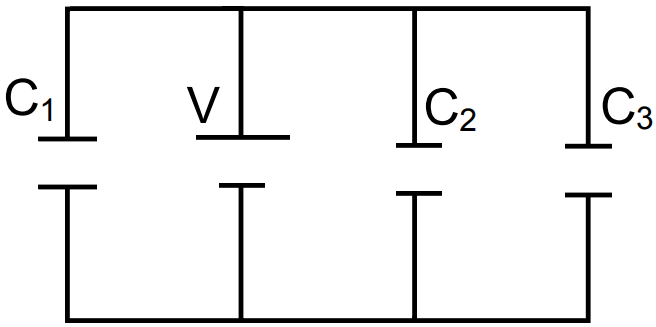
Find the charges on the three capacitors connected to a battery as shown in figure. Take $\text{C}_1=2.0\mu\text{F},\ \text{C}_2=4.0\mu\text{F},\ \text{C}_3=6.0\mu\text{F}$ and V = 12 volts.

A uniform conducting wire of length 12a and resistance R is wound up as a current carrying coil in the shape of:
  1. An equilateral triangle of side a.
  2. A square of sides a.
  3. A regular hexagon of sides a. The coil is connected to a voltage source V0. Find the magnetic moment of the coils in each case.
Explain : Bar magnet as an equivalent solenoid.
A carrom board (4ft × 4ft square) has the queen at the centre. The queen, hit by the striker moves to the front edge, rebounds and goes in the hole behind the striking line. Find the magnitude of displacement of the queen:
  1. From the centre to the front edge.
  2. From the front edge to the hole.
  3. From the centre to the hole.
The magnifying power of a simple microscope is given by $1+\frac{\text{D}}{\text{f}},$ where D is the least distance for clear vision. For farsighted persons, D is greater than the usual. Does it mean that the magnifying power of a simple microscope is greater for a farsighted person as compared to a normal person? Does it mean that a farsighted person can see an insect more clearly under a microscope than a normal person?
The first excited energy of a He+ ion is the same as the ground state energy of hydrogen. Is it always true that one of the energies of any hydrogen-like ion will be the same as the ground state energy of a hydrogen atom?