Question
  1. Derive the expression for the torque on a rectangular current carrying loop suspended in a uniform magnetic field.
  2. A proton and a deuteron having equal momenta enter in a region of uniform magnetic field at right angle to the direction of the field. Depict their trajectories in the field.

Answer

  1.  

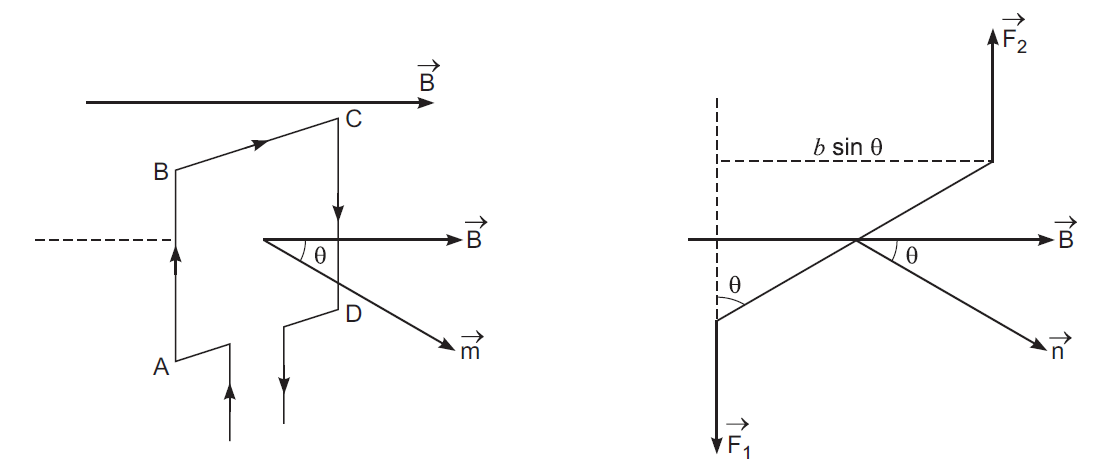
A rectangular loop ABCD of dimensions l and b, carrying a steady current is placed in uniform magnetic field as shown in fig; such that normal of the plane is at angle q with the magnetic field lines.

The force FBC and FAD on arms BC and AD are equal, opposite and along the axis of the coil, so they cancel each other.

The forces FAB and FCD are also equal and opposite, but are not collinear, so they constitute a couple, and the magnitude of the torque can be given as

$\tau = \text{F}_{AB}.\frac{\text{b}}{2}\sin\theta + \text{F}_{CD}.\frac{\text{b}}{2}\sin\theta$

Since

$|\text{F}_{AB}| = |\text{F}_{CD}| =\text{BI}\ell$

$\tau = \text{BI}\ell\times\text{b}\times\sin\theta$

$ = \text{BI}(\ell\text{b})\sin\theta$

= BI A sin $\theta$

$[\text{A} = \ell \text{b} = \text{ area of the rectangle}]$

Since magnetic moment m = I |A|

$\tau = \text{mB} \sin \theta$

In vector from $\overrightarrow{\tau} = \overrightarrow{\text{m}}\times\overrightarrow{\text{B}}$

  1. If a charge particle enters right angle to the direction of magnetic field, it follows a circular trajectory, and radius can be given as

$\text{q}v\text{B} = \frac{\text{m}v^{2}}{\text{r}}$

$\Rightarrow\text{r} = \frac{\text{m}v}{\text{qB}} = \frac{\text{p}}{\text{qB}}$

Since momentum are equal, and they have equal charges.

So, rp : rd = 1:1.
Need a full question paper?

Generate a complete, print-ready paper with questions like this in minutes — across 16+ boards, with answer keys.

Start Generating Free

Similar questions

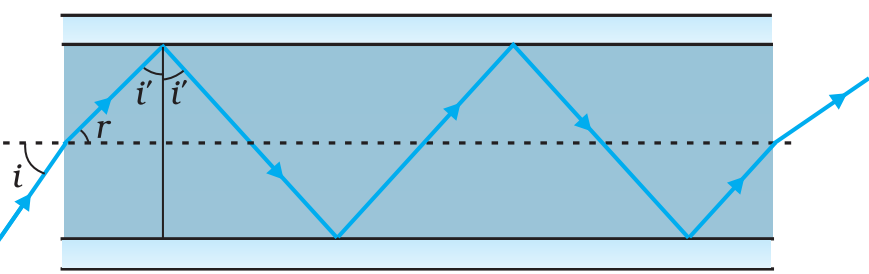
  1. a cross - section of a ‘light pipe’ made of a glass fibre of refractive. The outer covering of the pipe is made of a material of refractive. What is the range of the angles of the incident rays with the axis of the pipe for which total reflections inside the pipe take place, as shown in the figure.
  2. What is the answer if there is no outer covering of the pipe?

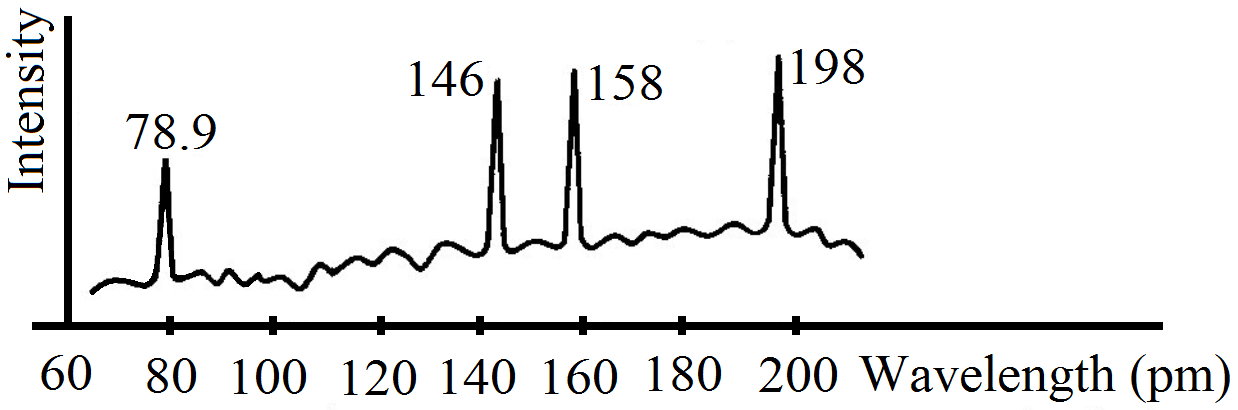
Continuous X-rays are made to strike a tissue paper soaked with polluted water. The incoming X-rays excite the atoms of the sample by knocking out the electrons from the inner shells. Characteristic X-rays are analysed and the intensity is plotted against the wavelength. Assuming that only $\text{K}_\alpha$ intensities are detected, list the elements present in the sample from the plot. Use Moseley's equation v - (25 × 1014Hz)(Z - 1)2.

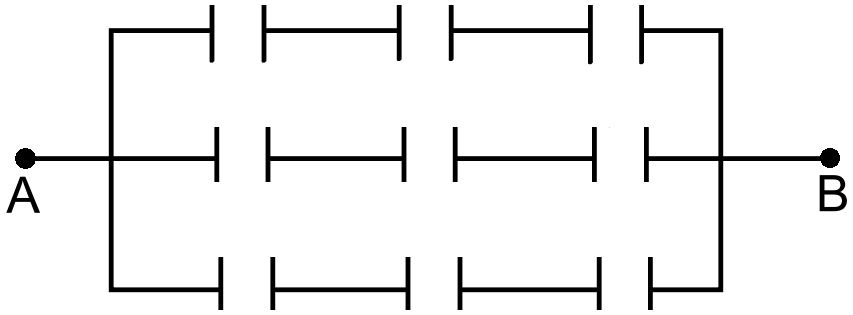
Each of the capacitors shown in figure has a capacitance of $2\mu\text{F}.$ Find the equivalent capacitance of the assembly between the points A and B. Suppose, a battery of emf 60 volts is connected between A and B. Find the potential difference appearing on the individual capacitors.

An electric bulb is designed to consume 55W when operated at 110 volts. It is connected to a 220V, 50Hz line through a choke coil in series. What should be the inductance of the coil for which the bulb gets correct voltage?
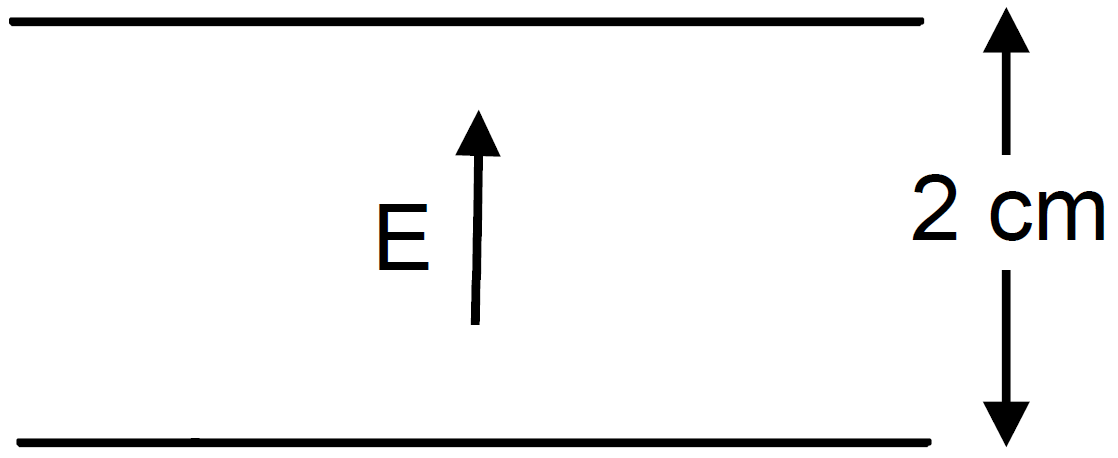
An electric field of magnitude 1000NC-1 is produced between two parallel plates having a separation of 2.0cm as shown in figure.

  1. What is the potential difference between the plates?
  2. With what minimum speed should an electron be projected from the lower plate in the direction of the field so that it may reach the upper plate?
  3. Suppose the electron is projected from the lower plate with the speed calculated in part (b). The direction of projection makes an angle of 60° with the field. Find the maximum height reached by the electron.

A block of mass m is placed on a smooth inclined plane of inclination 0 with the horizontal. The force exerted by the plane on the block has a magnitude:

  1. $\text{mg}$

  2. $\frac{\text{mg}}{\cos\theta}$

  3. $\text{mg}\cos\theta$

  4. $\text{mg}\tan\theta$

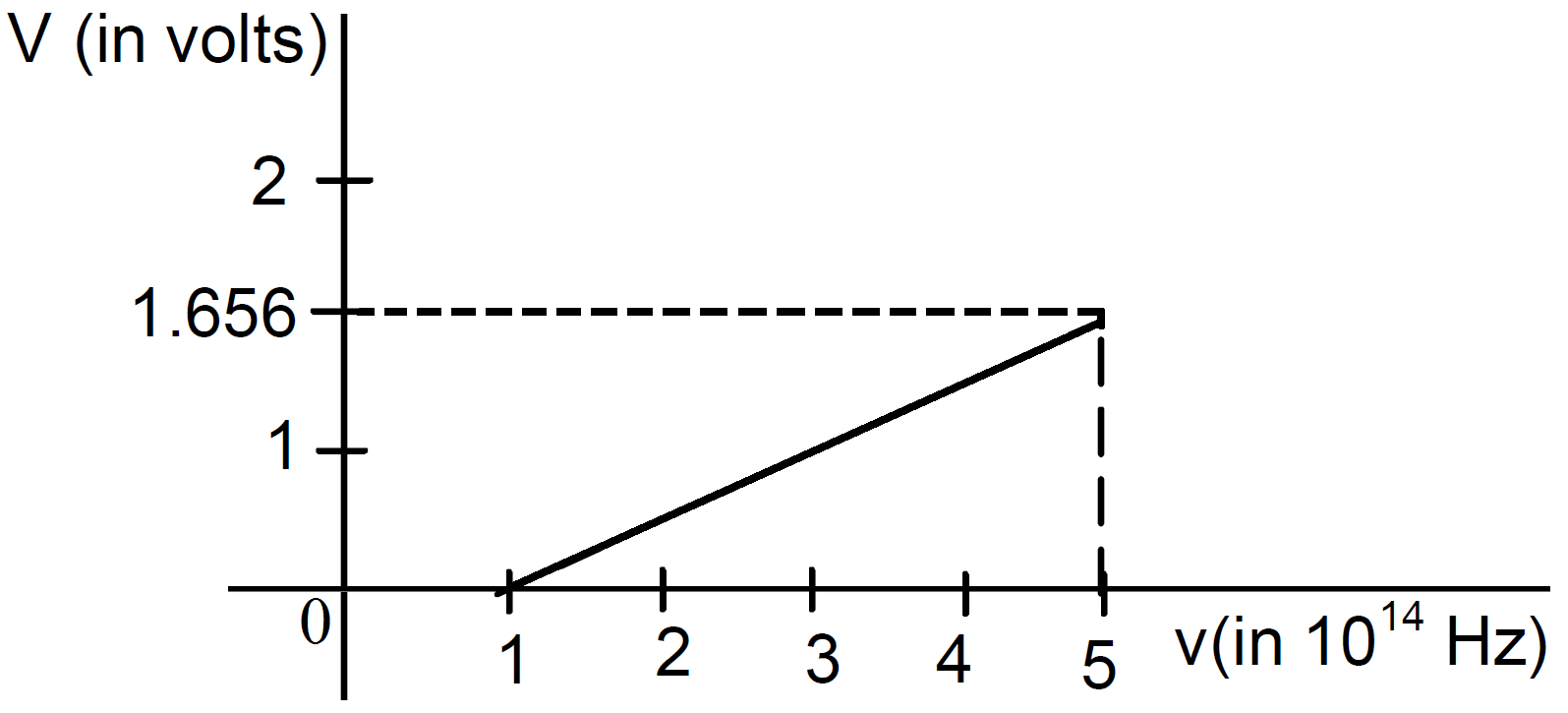
Figure is the plot of the stopping potential versus the frequency of the light used in an experiment on photoelectric effect. Find.

  1. The ratio h/e and.
  2. The work function.

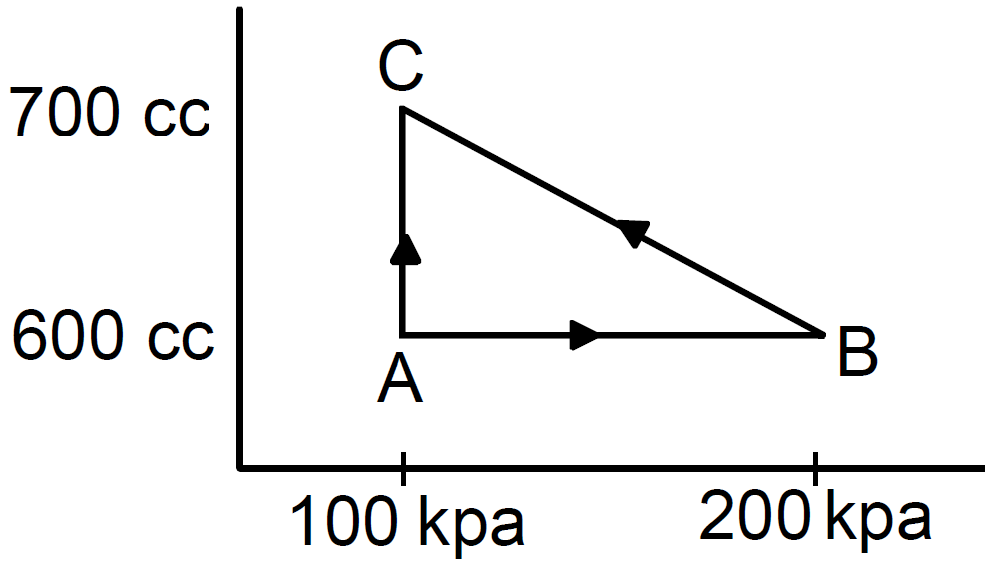
A gas is taken through a cyclic process ABCA as shown in figure. If 2.4 cal of heat is given in the process, what is the value of J?

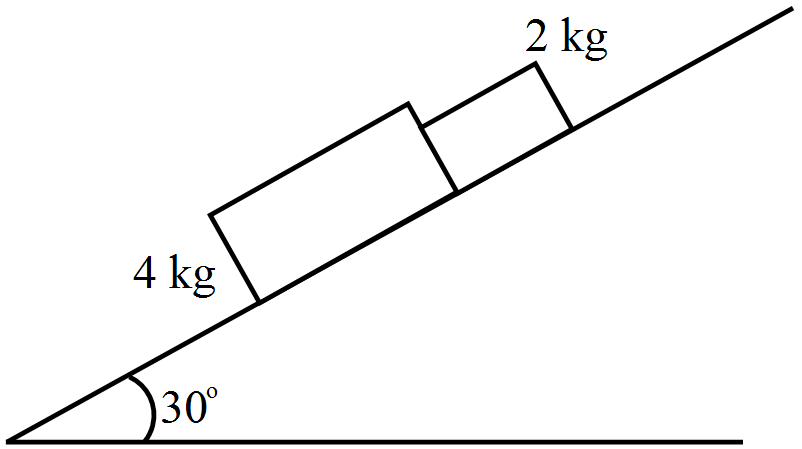
Figure shows two blocks in contact sliding down an inclined surface of inclination 30°. The friction coefficient between the block of mass 2.0kg and the incline is $\mu_1,$ and that between the block of mass 4.0kg and the incline is $\mu_2.$ Calculate the acceleration of the 2.0kg block if:

  1. $\mu_1=0.20$ and $\mu_2=0.30$
  2. $\mu_1=0.30$ and $\mu_2=0.20$ Take $\text{g}=10\text{m/s}^2.$