Question
Derive the formula (/ equation) of capacitance for a paralled plate capacitor.

Answer

Image
A capacitor made up of two large parallel conducting plates kept at a small distance is called parallel plate capacitor.
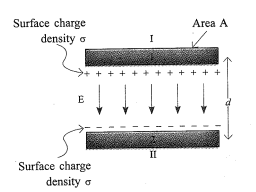
Two parallel conducting plates are arranged parallel to each other as shown in figure. Area of each plate is A and perpendicular distance between the two plates is $d$. Charge on them is + Q and - Q respectively.
Surface charge density on both the plates is $\sigma\left(=\frac{ Q }{ A }\right)$ and $-\sigma$ respectively.
Here the separation (d) between two plates is very small compared to the area of the plates. ( $d^2 \ll<$ A) Therefore, the electric field between the two plates can be considered uniform (So that we can use the formula $E=\frac{\sigma}{2 \varepsilon_0}$ to find out electric field due to both plates.) Electric field in the region above plate I , $E ^{\prime}=\frac{\sigma}{2 \varepsilon_0}-\frac{\sigma}{2 \varepsilon_0}=0$
Electric field in the region below plate II, $E ^{\prime \prime}=\frac{\sigma}{2 \varepsilon_0}-\frac{\sigma}{2 \varepsilon_0}=0$

Electric field in the region above plate I,
$E ^{\prime}=\frac{\sigma}{2 \varepsilon_0}-\frac{\sigma}{2 \varepsilon_0}=0$

Electric field in the region below plate $\Pi$,
$E ^{\prime \prime}=\frac{\sigma}{2 \varepsilon_0}-\frac{\sigma}{2 \varepsilon_0}=0$

Electric field in the region between two plates,
$\begin{array}{l}
\therefore E =\frac{\sigma}{2 \varepsilon_0}+\frac{\sigma}{2 \varepsilon_0} \\
\therefore E =\frac{\sigma}{\varepsilon_0} \\
\therefore E =\frac{ Q }{\varepsilon_0 A}
\end{array}$
$\left(\because \sigma=\frac{ Q }{ A }\right)$

Direction of this electric field is from +ve plate to -ve plate.
The electric field is limited to the region between two plates and is uniform in that entire region.

Need a full question paper?

Generate a complete, print-ready paper with questions like this in minutes — across 16+ boards, with answer keys.
Start Generating Free

Similar questions

A body of mass 2kg suspended through a vertical spring executes simple harmonic motion of period 4s. If the oscillations are stopped and the body hangs in equilibrium, find the potential energy stored in the spring.
A semicircular wire has a length L and mass M.A particle of mass m is placed at the centre of the circle. Find the gravitational attraction on the particle due to the wire.
  1. Define self-inductance. Write its SI units.
  2. A long solenoid with 15 turns per cm has a small loop of area 2.0 cm2 placed inside the solenoid normal to its axis. If the current carried by the solenoid changes steadily from 2.0 A to 4.0 A in 0.1 s, what is the induced emf in the loop while the current is changing?
A capacitor is connected to an alternating-current source. Is there a magnetic field between the plates?
Two long and parallel straight wires A and B carrying currents of 8.0 and 5.0 A in the same direction are separated by a distance of 4.0 cm. Estimate the force on a 10 cm section of wire A.
(a) A closed loop is held stationary in the magnetic field between the north and south poles of two permanent magnets held fixed. Can we hope to generate current in the loop by using very strong magnets?
(b) A closed loop moves normal to the constant electric field between the plates of a large capacitor. Is a current induced in the loop (i) when it is wholly inside the region between the capacitor plates (ii) when it is partially outside the plates of the capacitor? The electric field is normal to the plane of the loop.
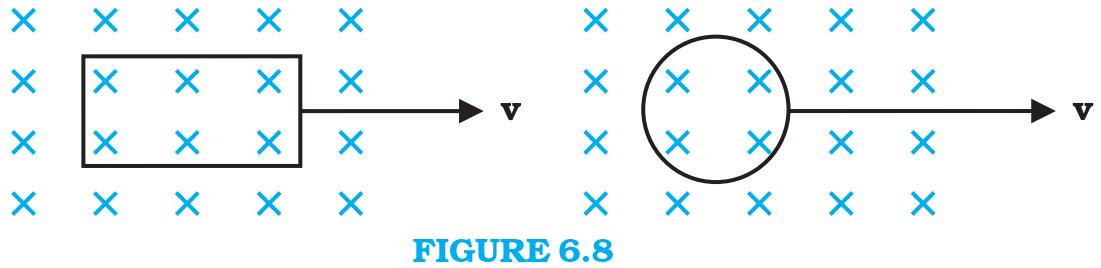
(c) A rectangular loop and a circular loop are moving out of a uniform magnetic field region (Fig. 6.8) to a field-free region with a constant velocity $v$. In which loop do you expect the induced emf to be constant during the passage out of the field region? The field is normal to the loops.
Image
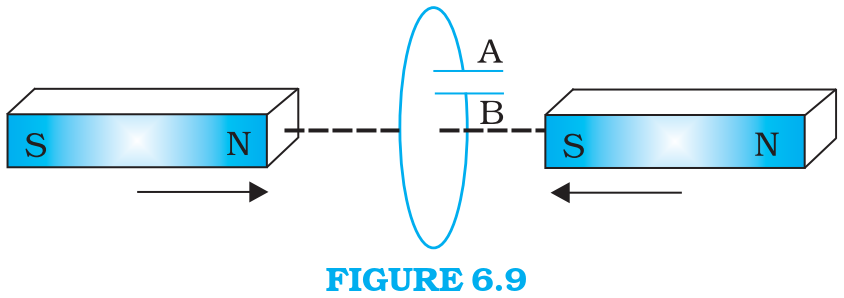
(d) Predict the polarity of the capacitor in the situation described by Fig. 6.9.

Image
Find the binding energy per nucleon of $\text{ }^{197}_{79}\text{Au}$ if its atomic mass is 196.96u.
Obtain approximately the ratio of the nuclear radii of the gold isotope $^{197}_{79}\text{Au}$ and the silver isotope $^{107}_{47}\text{Ag}.$
A simple pendulum of lerigth 1 feet suspended from the ceiling of an elevator takes $\frac{\pi}{3}$ seconds to complete one oscillation. Find the acceleration of the elevator.