Question
Derive the formula for centripetal acceleration of a particle moving with constant speed on a plane circular path. Or Derive the formula of acceleration for a particle moving with uniform speed on a circular path and tell its direction.

Answer

self

Need a full question paper?

Generate a complete, print-ready paper with questions like this in minutes — across 16+ boards, with answer keys.
Start Generating Free

Similar questions

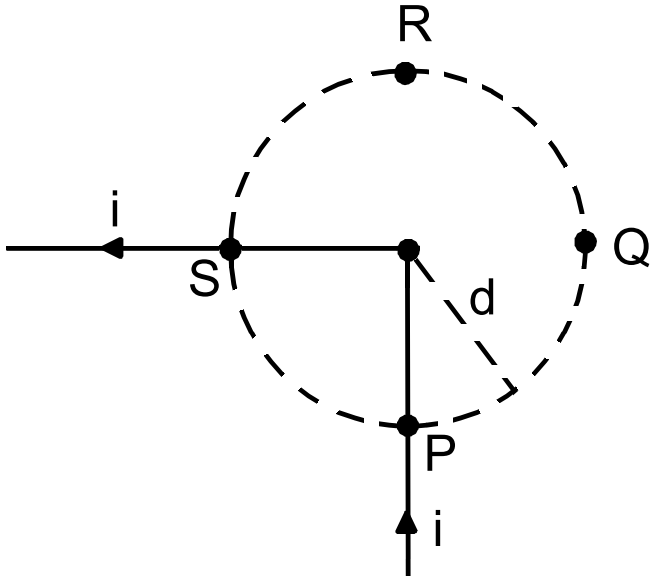
Figure shows a long wire bent at the middle to form a right angle. Show that the magnitudes of the magnetic fields at the points P, Q, R and S are equal and find this magnitude.
A body covers $12m$ in $2^{nd}$ second and $20m$ in $4^{th}$ second. Find what distance the body will cover in $4$ second after $5^{th}$ second.
Write the theorem of perpendicular and parallel axes of moment of inertia.
A and B are two particles having the same mass 'm'. A is moving along x-axis with a speed of $10ms^{-1}$ and B is at rest. After undergoing a perfectly elastic collision with B, particle A get scattered through an angle of $30°$. What is the direction of the motion of B and the speeds of A and B after the collision?
The length of a second’s pendulum on the surface of Earth is 1m. What will be the length of a second’s pendulum on the moon?
A quarterback, standing on his opponents 35-yard line, throws a football directly down field, releasing the ball at a height of 2.00m above the ground with an initial velocity of 20.0m/ s, directed 30.0° above the horizontal.
  1. How long does it take for the ball to cross the goal line, 32.0m from the point of release?
  2. The ball is thrown too hard and so passes over the head of the intended receiver at the goal line. What is the ball's height above the ground as it crosses the goal line?
  1. What is an adiabatic process? Derive expression for the work done during such process.
  2. A refrigerator is to maintain eatable kept inside at $9^\circ C$. If the room temperature is $36^\circ C$. Calculate the co-efficient of performance.
Estimate the mean free path and collision frequency of a nitrogen molecule in a cylinder containing nitrogen at 2.0 atm and temperature 17°C. Take the radius of a nitrogen molecule to be roughly $1.0\mathring{\text{A}}$ Compare the collision time with the time the molecule moves freely between two successive collisions (Molecular mass of $N^2 = 28.0u$).
In a Young's double slit experiment, the separation between the slits = $2.0mm$, the wavelength of the light = $600nm$ and the distance of the screen from the slits = $2.0m$. If the intensity at the centre of the central maximum is $0.20W/ m^2$, what will be the intensity at a point $0.5cm$ away from this centre along the width of the fringes?
Using the correspondence of S.H.M. and uniform circular motion, find displacement, velocity, amplitude, time period and frequency of a particle executing S.H.M?