Question
Derive the formula for electrostatic potential due to a point charge.

Answer

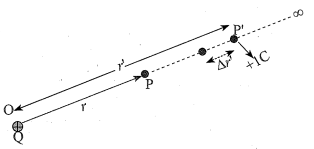
Image

As shown in fig., charge $Q(Q>0)$ is placed on the origin of the cartesian co-ordinates system. We want to find electric potential at some point P , having its position vector $\vec{r}$ from origin O. For this we should calculate work done by external force in bringing unit positive charge (test charge) from infinity to point $P$.
Suppose, there is a point $P ^{\prime}$ at distance $r^{\prime}$ in between the path from infinity to P .
Force on unit positive charge kept at point $P ^{\prime}$ is
$\overrightarrow{ F }^{\prime}=\frac{1}{4 \pi \varepsilon_0} \cdot \frac{ Q }{r^{\prime^2}} \cdot \hat{r}^{\prime}$

Where $\hat{r}^{\prime}$ is the unit vector in the direction of $\overrightarrow{ OP ^{\prime}}$.

The work done against the (field) force in giving $\overrightarrow{\Delta r^{\prime}}$ displacement to the unit positive charge,
$\Delta W =-\frac{1}{4 \pi \varepsilon_0} \cdot \frac{ Q }{r^{\prime 2}} \cdot \Delta r^{\prime}$

Need a full question paper?

Generate a complete, print-ready paper with questions like this in minutes — across 16+ boards, with answer keys.
Start Generating Free

Similar questions

The three stable isotopes of neon: $^{20}_{10}\text{Ne},\ ^{21}_{10}\text{Ne }\text{ and }\ ^{22}_{10}\text{Ne}$ have respective abundances of 90.51%, 0.27% and 9.22%. The atomic masses of the three isotopes are 19.99 u, 20.99 u and 21.99 u, respectively. Obtain the average atomic mass of neon.
Can you hear your own words if you are standing in a perfect vacuum? Can you hear your friend in the same conditions?
The refractive index of a material changes by 0.014 as the colour of the light changes from red to violet. A rectangular slab of height 2.00cm made of this material is placed on a newspaper. When viewed normally in yellow light, the letters appear 1.32cm below the top surface of the slab. Calculate the dispersive power of the material.
A convex lens of focal length 25 cm is placed coaxially in contact with a concave lens of focal length 20 cm. Determine the power of the combination. Will the system be converging or diverging in nature?
A bob suspended from the ceiling of a car which is accelerating on a horizontal road. The bob stays at rest with respect to the car with the string making an angle $\theta$ with the vertical. The linear momentum of the bob as seen from the road is increasing with time. Is it a violation of conservation of linear momentum? If not, where is the external force which changes the linear momentum?
Does short-sightedness (myopia) or long-sightedness (hypermetropia) imply necessarily that the eye has partially lost its ability of accommodation? If not, what might cause these defects of vision?
A nearsighted person cannot clearly see beyond 200cm. Find the power of the lens needed to see objects at large distances.
Show that the interior of a conductor can have no excess charge in the static situation.
Consider Experiment 6.2. (a) What would you do to obtain a large deflection of the galvanometer? (b) How would you demonstrate the presence of an induced current in the absence of a galvanometer?
Explain quantisation of charge.