Question
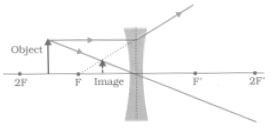
Derive the lens formula,  $\frac{1}{\text{f}} = \frac{1}{\text{v}} - \frac{1}{\text{u}}$ for a concave lens, using the necessary ray diagram.
Two lenses of powers 10 D and – 5 D are placed in contact.
  1. Calculate the power of the new lens.
  2. Where should an object be held from the lens, so as to obtain a virtual image of magnification 2?

Answer

Diagram:

Derivation: $\frac{1}{\text{v}} -\frac{1}{\text{u}} = \frac{1}{\text{f}}$

  1. $\text{Power} = \text{P}_{1} + \text{P}_{2}$

$ = 10 - 5 = 5\text{D}$

  1. f = 20 cm

 $\text{m} = \frac{\text{v}}{\text{u}} = 2$

$\frac{1}{\text{f}} =\frac{1}{\text{v}} - \frac{1}{\text{u}}$

$\text{u} = -10\text{cm}.$

Need a full question paper?

Generate a complete, print-ready paper with questions like this in minutes — across 16+ boards, with answer keys.

Start Generating Free

Similar questions

A body of weight w1 is suspended from the ceiling of a room through a chain of weight w2. The ceiling pulls the chain by a force:
  1. w1
  2. w2
  3. w1 + w2
  4. $\frac{\text{w}_1+\text{w}_2}{2}$
A 600pF capacitor is charged by a 200V supply. It is then disconnected from the supply and is connected to another uncharged 600 pF capacitor. How much electrostatic energy is lost in the process?
  1.  
  1. Draw a labelled ray diagram to show the formation of image in an astronomical telescope for a distant object.
  2. Write three distinct advantages of a reflecting type telescope over a refracting type telescope.
  1. A convex lens of focal length 10 cm is placed coaxially 5 cm away from a concave lens of focal length 10 cm. If an object is placed 30 cm in front of the convex lens, find the position of the final image formed by the combined system.
ODBAC is a fixed rectangular conductor of negilible resistance (CO is not connnected) and OP is a conductor which rotates clockwise with an angular velocity $\omega$ (Fig). The entire system is in a uniform magnetic field B whose direction is along the normal to the surface of the rectangular conductor ABDC. The conductor OP is in electric contact with ABDC. The rotating conductor has a resistance of $\lambda$ per unit length. Find the current in the rotating conductor, as it rotates by 180º.

Fig. shows the electric field lines around three point charges A, B and C.

  1. Which charges are positive?
  2. Which charge has the largest magnitude? Why?
  3. In which region or regions of the picture could the electric field be zero? Justify your answer.
  1. Near A,
  2. Near B,
  3. Near C,
  4. Nowhere.
A person standing on the floor of an elevator drops a coin. The coin reaches the floor of the elevator in a time t1 if the elevator is stationary and in time t2 if it is moving uniformly. Then:
  1. t1 = t2
  2. t1 < t2
  3. t1 > t2
  4. t1 < t2 or t1 > t2 depending on whether the lift is going up or down.
A block of mass 2.0kg kept at rest on an inclined plane of inclination 37° is pulled up the plane by applying a constant force of 20N parallel to the incline. The force acts for one second.
  1. Show that the work done by the applied force does not exceed 40J.
  2. Find the work done by the force of gravity in that one second if the work done by the applied force is 40J.
  3. Find the kinetic energy of the block at the instant the force ceases to act. Take g = 10m/s2.
An air-filled parallel-plate capacitor is to be constructed which can store $12\mu\text{C}$ of charge when operated at 1200V. What can be the minimum plate area of the capacitor? The dielectric strength of air is 3 × 10⁶Vm-1.
A series L-C-R circuit is connected to an AC source. Using the phasor diagram, derive the expression for the impedance of the circuit. Plot a graph to show the variation of current with frequency of the source, explaining the nature of its variation.
A town has a population of 1 million. The average electric power needed per person is 300W. A reactor is to be designed to supply power to this town. The efficiency with which thermal power is converted into electric power is aimed at 25%.
  1. Assuming 200MeV to thermal energy to come from each fission event on an average, find the number of events that should take place every day.
  2. Assuming the fission to take place largely through 235U, at what rate will the amount of 235U decrease? Express your answer in kg per day.
  3. Assuming that uranium enriched to 3% in 235U will be used, how much uranium is needed per month (30 days)?