Question
Derive the lens formula $\frac{1}{\text{f}}=\frac{1}{\text{v}}-\frac{1}{\text{u}}$ for a thin concave lens, using the necessary ray diagram.
Answer

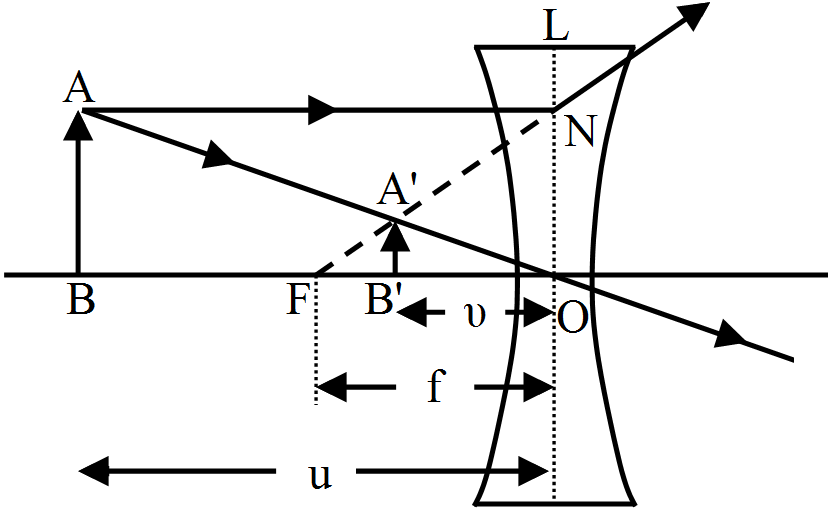
The formation of image by a concave lens 'L' is shown in fig. AB is object and A' B' is the image. Triangles ABO and A' B' O are similar

$\frac{\text{AB}}{\text{A}'\text{B}}=\frac{\text{OB}}{\text{OB}'}\dots(\text{i})$

Also triangles NOF and A' B' F are similar

$\frac{\text{NO}}{\text{A}'\text{B}}=\frac{\text{OP}}{\text{FB}'}$

But NO = AB

$\frac{\text{AB}}{\text{A}'\text{B}'}=\frac{\text{OB}}{\text{FB}'}\dots(\text{i})$

Comparing equation (i) and (ii)

$\frac{​\text{OB}​}{\text{OB}'}=\frac{\text{OF}}{\text{FB}'}$

$\Rightarrow\frac{\text{OB}}{\text{OB}'}=\frac{\text{OF}}{\text{OF}-\text{OB}'}$

Using sign conventions of coordinate geometry

OB = -u, OB' = -v, OF = -f

$\frac{-\text{u}}{-\text{v}}=\frac{-\text{f}}{-\text{f}+\text{v}}$

$\Rightarrow\text{uf}-\text{uv}=\text{vf}$

$\Rightarrow\text{uv}=\text{uf}-\text{uf}$

Dividing throughout by uvf, we get

$\frac{1}{\text{f}}=\frac{1}{\text{v}}-\frac{1}{\text{u}}$

This is the required lens formula.

Need a full question paper?

Generate a complete, print-ready paper with questions like this in minutes — across 16+ boards, with answer keys.
Start Generating Free

Similar questions

A hollow tube has a length l1 inner radius R1 and outer radius R2. The material has a thermal conductivity K. Find the heat flowing through the walls of the tube if.
  1. The flat ends are maintained at temperatures T1 and T2(T2 > T1)
  2. The inside of the tube is maintained at temperature T1 and the outside is maintained at T2.
$\text{ }^{212}_{33}\text{Bi}$ can disintegrate either by emitting an $\alpha$-particle of by emitting a $\beta^-$-particle.
  1. Write the two equations showing the products of the decays.
  2. The probabilities of disintegration $\alpha$ and $\beta$ -decays are in the ratio $\frac{7}{13}.$ The overall half-life of 212Bi is one hour. If 1g of pure 212Bi is taken at 12.00 noon, what will be the composition of this sample at 1P.m. the same day?
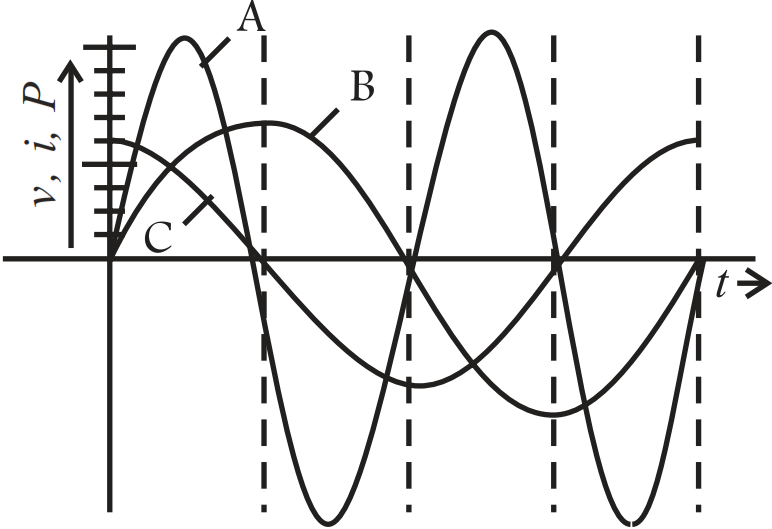
A device 'X' is connected to an a.c source. The variation of voltage, current and power in one complete cycle is shown in Fig.

  1. Which curve shows power consumption over a full cycle?
  2. What is the average power consumption over a cycle?
  3. Identify the device 'X'.
In a plane electromagnetic wave, the electric field oscillates sinusoidally at a frequency of 2.0 × 10¹⁰ Hz and amplitude 48 V m-1.
  1. What is the wavelength of the wave?
  2. What is the amplitude of the oscillating magnetic field?
  3. Show that the average energy density of the E field equals the average energy density of the B field. [c = 3 × 10⁸ m s-1.]
Deutrium was discovered in 1932 by Harold Urey by measuring the small change in wavelength for a particular transition in 1H and 2H. This is because, the wavelength of transition depend to a certain extent on the nuclear mass. If nuclear motion is taken into account then the electrons and nucleus revolve around their common centre of mass. Such a system is equivalent to a single particle with a reduced mass μ, revolving around the nucleus at a distance equal to the electron-nucleus separation. Here $\mu=\frac{\text{m}_\text{e}\text{M}}{\text{m}_\text{e}+\text{M}}$ where M is the nuclear mass and me is the electronic mass. Estimate the percentage difference in wavelength for the 1st line of the Lyman series in 1H and 2H. (Mass of 1H nucleus is 1.6725 × 10-27kg, Mass of 2H nucleus is 3.3374 × 10-27kg, Mass of electron = 9.109 × 10-31kg).
A car travelling at 60km/h overtakes another car travelling at 42km/h. Assuming each car to be 5.0m long, find the time taken during the overtake and the total road distance used for the overtake.
Suppose all the electrons of 100g water are lumped together to form a negatively charged particle and all the nuclei are lumped together to form a positively charged particle. If these two particles are placed 10.0cm away from each other, find the force of attraction between them. Compare it with your weight.
Assume the dipole model for earth's magnetic field B which is given by BV = vertical component of magnetic field $=\frac{\mu_0}{4\pi}\frac{2\text{m}\cos\theta}{\text{r}^3}$
BH = Horizontal component of magnetic field $=\frac{\mu_0}{4\pi}\frac{\sin\theta\text{m}}{\text{r}^3}$
θ = 90º - lattitude as measured from magnetic equator. Find loci of points for which,
  1. |B| is minimum,
  2. Dip angle is zero,
  3. Dip angle is ± 45º.
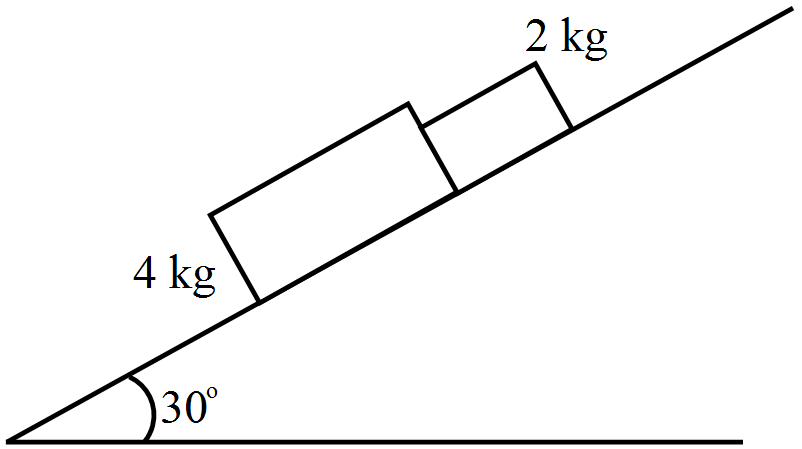
Figure shows two blocks in contact sliding down an inclined surface of inclination 30°. The friction coefficient between the block of mass 2.0kg and the incline is $\mu_1,$ and that between the block of mass 4.0kg and the incline is $\mu_2.$ Calculate the acceleration of the 2.0kg block if:

  1. $\mu_1=0.20$ and $\mu_2=0.30$
  2. $\mu_1=0.30$ and $\mu_2=0.20$ Take $\text{g}=10\text{m/s}^2.$

The capacitance between the adjacent plates shown in figure is 50nF. A charge of $1.0\mu\text{C}$ is placed on the middle plate:

  1. What will be the charge on the outer surface of the upper plate?
  2. Find the potential difference developed between the upper and the middle plates.