Surface tension tries to decrease the surface area of a liquid. For increasing surface area, the work has to be done against the surface tension and it is stored in the surface molecules in the form of potential energy
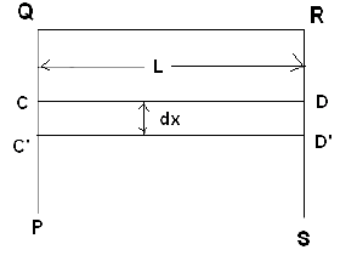
Consider a rectangular frame PQRS having a movable wire CD. Let QR = CD = L. If a soap film is formed on the frame CQRD, then the surface tension will try to pull the wire inward by a force F.
Surface tension \(=\frac{\text { Force }}{\text { free Length }}\)
\(F=\) Surface tension \(\times\) Free length
\(\therefore F = T \times(2 L )\)
If the wire is pulled out to C'D' through distance ‘dx’.
∴ Work done = F. dx
∴ W = T (2Ldx)
∴ W = T (2Ldx)
But increase in area = dA = 2Ldx
Surface energy is defined as the work done per unit area to increase the free surface area, under isothermal conditions.
\(\therefore\) Surface energy \(=\frac{\text { Work done }}{\text { Free surface area }}=\frac{W}{ dA }=\frac{T(2 L d x)}{2 L d x}=T\)
∴ Surface tension is also equal to the surface energy per unit area.