Question
Describe a clinical thermometer. How does it differ from the thermometer used in a laboratory?
When it is taken out of the patient’s body, the small constriction does not allow the mercury (or alcohol) from the stem to retreat into the bulb. Thus, this arrangement enables us to read the temperature of the patient’s body at ease after the removal of the thermometer from his body.
The clinical thermometer is graduated from 35 °C to 42 °C (or from 95 °F to 108 °F). At 37 °C (98.6 °F), there is a red arrow mark which indicates the temperature of a healthy person.
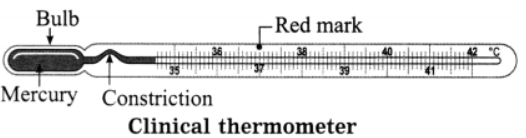
The thermometer used in a laboratory has wider range and does not have constriction like a clinical thermometer.
Generate a complete, print-ready paper with questions like this in minutes — across 16+ boards, with answer keys.