Question
Describe an experiment to prove that the pressure in a liquid increase with depth.

Answer

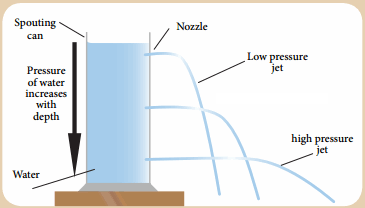
Take a plastic bottle. Punch three holes on its side in the same direction, but at different heights. Now pour some water into it and let it flow through the holes. Observe the flow of water.
Inference:
The water comes out from all the holes with a different force and falls on the table at points that are at variable distances from the bottle. Water from the lowest hole comes out with the greatest force and falls at a point that is at the maximum distance from the bottle. Water from the topmost hole comes out with the least force and falls at the point that is at the minimum distance from the bottle.Your friend was absent from school yesterday. You are enquiring about his absence. He told that he had a fever and it was measured to be 100oC. Is it possible to have a 100oC fever? If he is wrong, try to make him understand. Image
  • Reason:
    This activity confirms that the pressure in a liquid varies with the depth of the point of observation in it.

Need a full question paper?

Generate a complete, print-ready paper with questions like this in minutes — across 16+ boards, with answer keys.

Start Generating Free

Similar questions

Explain three ways of charge transfer.
Explain the different types of coal.
Crossword puzzle :
Across:
1. The acid found in apples.
3. The ion formed when an acid is dissolved in water.
5. An indicator that remains colourless in an acid.
7. The gas liberated when dilute hydrochloric acid reacts with limestone.
9. A gas that dissolved in water to form ammonium hydroxide.

Down:
2. An acid used for cooking.
4. An acid that has three hydrogen atoms in its moelcule.
6. A reaction in which an acid reacts w’ith a base to form salt and water only.
8. A base that is soluble in water.
10. The chemical name of this compound is calcium hydroxide.
How lightning takes place?
Cross word puzzle :
Across:
1. The mixture of gases that surrounds the Earth or some other celestial body.
3. A force acting normal to a surface.
5. The pressure exerted by air.
7. Something that causes a body to move, change its speed or direction, or distorts its shape.
9. The upward force that fluids exert on all matter.Down:
2. A unit used to measure pressure.
4. A unit used to measure force.
6. Amount of force applied per unit area.
8. An instrument for measuring atmospheric pressure.
10. The pressure exerted at any point on a enclosed liquid is transmitted equally and undiminished in all directions.
State the law of conservation of mass.
Explain any three conditions that are required for a chemical reaction to take place. Give example.
With the help of a neat diagram, explain the working of a calorimeter.
Friction is a necessary evil - Explain.
What is known as destructive distillation? Write about the products obtained from fractional distillation of petroleum.