Question
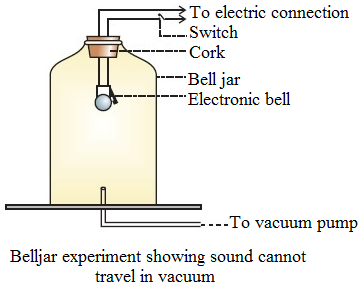
Describe an experiment to show that sound cannot pass through vacuum.

Answer

Sound cannot travel through vacuum. This can be shown by the following experiment:
  1. A ringing electric bell is placed inside an air tight glass jar containing air. We can hear the sound of ringing bell clearly. Thus, when air is present as medium in the bell jar, sound can travel through it and reach our ears.
  2. The bell jar containing ringing bell is placed over the plate of a vacuum pump. Air is gradually removed from the bell jar by switching on the vacuum pump. As more and more air is removed from the bell jar, the sound of ringing bell becomes fainter and fainter. And when all the air is removed from the bell jar, no sound can be heard at all. Thus, when vacuum is created in the bell jar, then the sound of ringing bell placed inside it cannot be heard.
This shows that sound cannot travel through vacuum.

Need a full question paper?

Generate a complete, print-ready paper with questions like this in minutes — across 16+ boards, with answer keys.
Start Generating Free

Similar questions

How will you separate a mixture of kerosene oil and water? Explain with the help of a labeled diagram
Explain the mechanism of compost formation.
Give the formulate of the compounds formed from the following sets of elements:
  1. Calcium and fluorine.
  2. Hydrogen and sulphur.
  3. Nitrogen and hydrogen.
  4. Carbon and chlorine.
  5. Sodium and oxygen.
  6. Carbon and oxygen.
Write the formulae for the following and calculate the molecular mass for each one of them.
$a.$ Caustic potash
$b.$ Baking powder
$c.$ Lime stone
$d.$ Caustic soda
$e.$ Ethanol
$f.$ Common salt
How bee colony works? What values can be seen in the organization of bee colony?
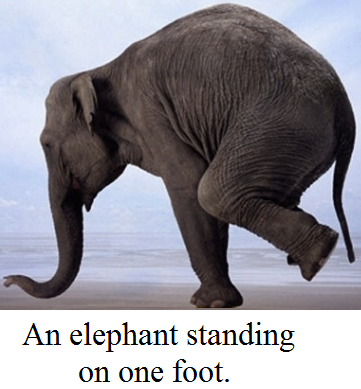
An elephant weighing $40,000N$ stands on one foot of area $1000\ cm^2$ whereas a girl weighing $400N$ is standing on one ‘stiletto’ heel of area $1\ cm^2$.
  1. Which of the two, elephant or girl, exerts a larger force on the ground and by how much?
  2. What pressure is exerted on the ground by the elephant standing on one foot?
  3. What pressure is exerted on the ground by the girl standing on one heel?
  4. Which of the two exerts larger pressure on the ground: elephant or girl?
  5. What is the ratio of pressure exerted by the girl to the pressure exerted by the elephant?
If one gram of sulphur contains $x$ atoms, calculate the number of atoms in one gram of oxygen element. $($Atomic masses: $S = 32u; O = 16u)$
Compare all the proposed models of an atom given in this chapter.
Describe Bohr’s model of the atom. How did Neils Bohr explain the stability of atom?
Describe an activity of determine the boiling point of water and melting point of ice.