p-Block Elements – I — Chemistry STD 12 — Question
Tamilnadu BoardEnglish MediumSTD 12Chemistryp-Block Elements – I5 Marks
Question
Describe briefly allotropism in p-block elements with specific reference to carbon.
✓
Answer
Some elements exist in more than one crystalline or molecular form in the same physical state. This phenomenon is called allotropism.
The most common allotropes of carbon are,
Graphite
Diamond
Fullerenes
Carbon nanotubes
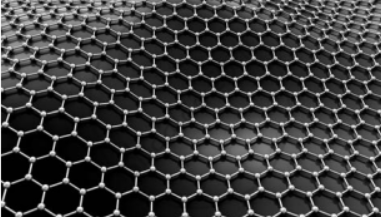
Graphene
1. Graphite:
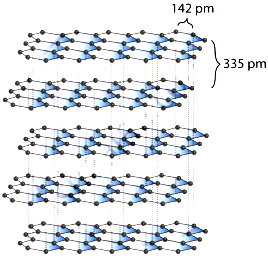
(i) It is the most stable allotropic form of carbon at normal temperature and pressure.
(ii) It is soft and conducts electricity.
(iii) It is composed of flat two-dimensional sheets of carbon atoms.
(iv) Each sheet is a hexagonal net of $sp^2$ hybridised carbon atoms with a C – C bond length of 1.41 Å. Structure of graphite
2. Diamond:
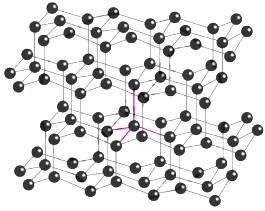
(i) It is very hard.
(ii) The carbon atoms in diamond are $sp^1$ hybridised, with a C – C bond length of 1.54 Å.
(iii) In the diamond, carbon atoms are arranged in a tetrahedral manner. Structure of Diamond
3. Fullerenes:
(i) It is a newly synthesised allotrope of carbon.
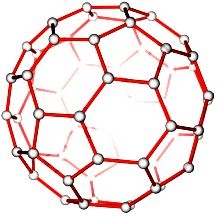
(ii) The $C_{60}$molecules have a soccer ball-like structure and is called buckminster fullerene or buckyballs.
(iii) It has a fused ring structure consists of 20 six-membered rings and 12 five-membered rings.
(iv) Each carbon atom is $sp^2$ hybridised.
(iv) The C – C bond distance is 1.44 A and the C = C distance is 1.38 Å. Structure of Fullerenes
4. Carbon nanotubes:
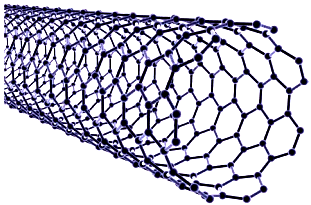
(i) It is recently discovered allotropes, have graphite-like tubes with fullerene ends.
(ii) These nanotubes are stronger than steel and conduct electricity. Structure of carbon nanotubes
5. Graphene:
It has a single planar sheet of $sp^2$ hybridised carbon atoms that are densely packed in a honeycomb crystals lattice. Structure of graphene
Need a full question paper?
Generate a complete, print-ready paper with questions like this in minutes — across 16+ boards, with answer keys.