Question
Describe briefly the following :
(a) Origin of replication, (b) Bioreactor, (c) Downstream processing.

Answer

(a) Origin of Replication : An origin of replication is @ sequence of DNA at which replication is initiated on a chromosome, plasmid or virus. For small DNAs, including bacterial plasmids and small viruses, a single origin is sufficient. Larger DNAs have many origins, and DNA replication is initiated at all of them; otherwise, if all replication had to proceed from a single origin, it would take too long to replicate the entire DNA mass.
The origin of replication determines the vector copy number, which could typically be in the range of 25-50 copies/cell if the expression vector is derived from the low-copy-number plasmid pBR322, or between 150 and 200 copies/cell if derived from the high-copy-number plasmid pUC. The copy number influences the plasmid stability, i.e., the maintenance of the plasmid within the cells during cells division.
The origin of replication also determines the plasmid's compatibility : its ability to replicate in conjunction with another plasmid within the same bacterial cell.
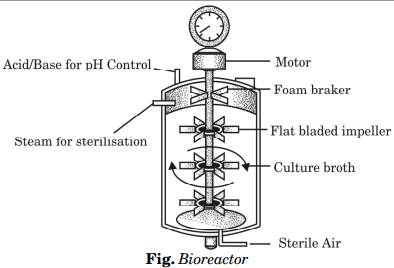
(b) Bioreactor : Bioreactors are large vessels used for large scale production of biotechnology products from the raw materials. Here, the raw materials are biologically converted into specific products, enzymes etc. using microbial plant, animal or human cells. They provide optimal conditions to obtain the desired product by providing the optimum temperature, pH, vitamin, oxygen etc.
The most commonly used bioreactors are of stirring type (stirred-tank reactor). Stirred tank bioreactor is usually cylindrical or with a curved base to facilitate the mixing of the reactor contents. The stirrer facilitates even mixing and oxygen availability. Alternatively air can be bubbled through the reactor. The bioreactor has an agitator system, an oxygen delivery system, a foam control system, a temperature control system, pH control system and sampling ports (for periodic withdrawal of the culture).
Image
(c) Downstream Processing : Downstream processing refers to the recovery and the purification of biosynthetic products, particularly pharmaceuticals, from natural sources such as animal or plant tissue or fermentation broth, including the recycling of salvegeable components and the proper treatment and disposal of waste. It is an essential step in the manufacture of pharmaceuticals such as antibiotics, hormones (e.g. insulin and humans growth hormone), antibodies (e.g. infliximab and abciximab) and vaccines; antibodies and enzymes used in diagnostics; industrial enzymes; and natural fragrance and flavor compounts, downstream processing is usually considered a specialized field in biochemical engineering, itself a specialization within chemical engineering, though many of the key technologies were developed by chemists and biologists for laboratory-scale separation of biological products.

Need a full question paper?

Generate a complete, print-ready paper with questions like this in minutes — across 16+ boards, with answer keys.
Start Generating Free