Question
Describe components of phloem. Define translocation.

Answer

Phloem is made up of four types of elements: Sieve tubes, companion cells, phloem fibres and the phloem parenchyma.
  1. Sieve tubes: These are tubular cells with perforated walls. These cells are responsible for transportation of food and nutrients.
  2. Companion cells: These cells are found associated with sieve tubes and connected with it by simple pits. These cells are long, narrow and thin walled. These cells are living.
  3. Phloem fibres: They have thick cell wall and they provide mechanical support to plant.
  4. Pholem parenchyma: These cells are living and often cylindrical in shape.
The transport of food from leaves to other parts of the plant is called translocation

Need a full question paper?

Generate a complete, print-ready paper with questions like this in minutes — across 16+ boards, with answer keys.
Start Generating Free

Similar questions

Explain the various methods of crop improvement. Name one improved variety of Rice, Maize, Soybean, Sunflower and Mustard.
A body of $2\ kg$ falls from rest. What will be its kinetic energy during the fall at the end of $2s?\ ($Assume $g = 10\ m/s^2)$
Suggest some preventive measures for the diseases of poultry birds.
What are longitudinal waves and transverse waves? Explain with the help of labelled diagrams.
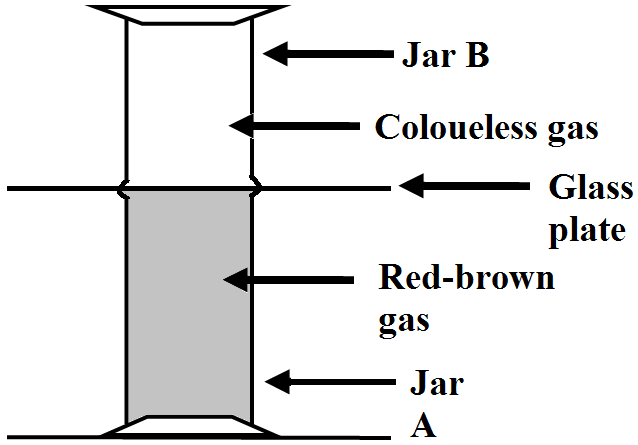
Look at the diagram on the right side. Jar A contains are d-brown gas whereas Jar B contains a colourless gas. The two gas jars are separated by a glass plate placed between them:
  1. What will happen when the glass plate between the two jars is pulled away?
  2. What name is given to the phenomenon which takes place?
  3. Name the brown gas which could be in jar A.
  4. Which is the colorless gas most likely to be present in jar B?
  5. Name one coloured solid and one colourless liquid which can show the same phenomenon.
A ball of mass $200g$ falls from a height of $5$ metres. What is its kinetic energy when it just reaches the ground? $(g = 9.8\ m/s).$
Give reasons for:
Meristematic cells have a prominent nucleus and dense cytoplasm but they lack vacuole.
Write the formulae for the following and calculate the molecular mass for each one of them.
$a.$ Caustic potash
$b.$ Baking powder
$c.$ Lime stone
$d.$ Caustic soda
$e.$ Ethanol
$f.$ Common salt
What mass of nitrogen $N_2,$ will contain the same number of molecules as $1.8g$ of water, $H_2O?$
$($Atomic masses: $N = 14u; H = 1u; O = 16u)$
How does the force of attraction between the two bodies depend upon their masses and distance between them?