Question
Describe different outbreeding devices in detail.###Describe different devices to discourage self pollination.###Describe different devices to encourage cross pollination.

Answer

→ Majority of flowering plants produce hermaphrodite (bisexual) flowers and pollen grains are likely to come in contact with the stigma of the same flower. Continued self-pollination result in inbreeding depression.
→ Flowering plants have developed many devices to discourage self-pollination and to encourage cross-pollination.
→ Dichogamy - In some species, pollen release and stigma receptivity are not synchronised. Either the pollen is released before the stigma becomes receptive or stigma becomes receptive much before the release of pollen.
→ Heterostyly - In some other species, the anther and stigma are placed at different positions so that the pollen cannot come in contact with the stigma of the same flower.
→ Both these devices prevent autogamy.
→ Self-incompatibility - This is a genetic mechanism and prevents self-pollen (from the same flower or other flowers of the same plant) from fertilising the ovules by inhibiting pollen germination or pollen tube growth in the pistil.
→ Dicliny/Unisexuality It is the production of unisexual flowers.
→ If both male and female flowers are present on the same plant such as castor and maize (monoecious), it prevents autogamy but not geitonogamy.
→ In several species such as papaya, male and female flowers are present on different plants, that is each plant is either male or female (dioecy). This condition prevents both autogamy and geitonogamy.

Need a full question paper?

Generate a complete, print-ready paper with questions like this in minutes — across 16+ boards, with answer keys.
Start Generating Free

Similar questions

Give information about primary and secondary lymphoid organ ### Explain lymphatic organs of human lymphatic system. (Diagram is not required)
Read the following and answer any four questions from (i) to (v) given below:
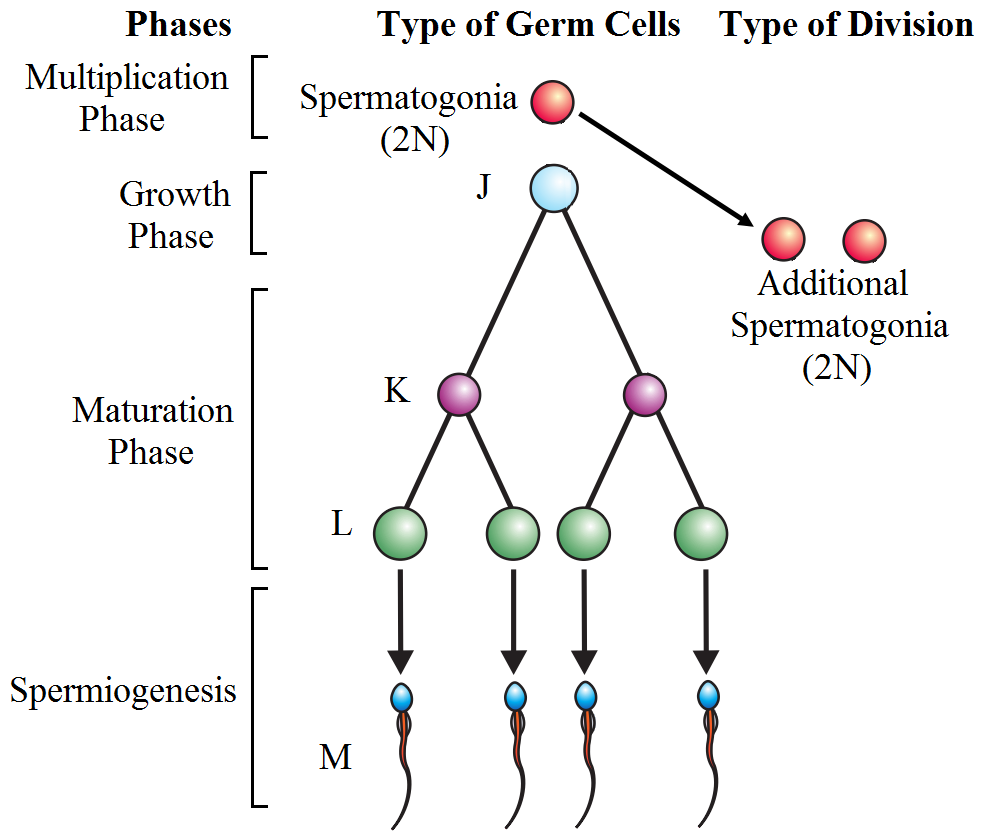
In testis, the immature male germ cells produce sperms by spermatogenesis that begins at puberty. It occurs in the seminiferous tubules of the testes. Seminiferous tubules are lined by germinal epithelium. Study the schematic representation of spermatogenesis and answer the following questions.

  1. Which cell division occurs during multiplication phase?
  1. Mitosis.
  2. Meiosis I.
  3. Meiosis II.
  4. Both (b) and (c).
  1. How many chromosomes are present in secondary spermatocyte and spermatid, respectively?
  1. 46, 23
  2. 46, 46
  3. 23, 23
  4. 23, XY
  1. Transformation of L into M is known as:
  1. Spermiation.
  2. Spermateliosis.
  3. Spermatogenesis.
  4. None of these.
  1. Select the correct option.
  1. Type A spermatogonia grows to larger primary spermatocyte.
  2. One spermatogonium forms two spermatids.
  3. Spenniation is the release of sperms from seminiferous tubules.
  4. Primary spermatocyte undergoes mitosis to form secondary spermatocytes.
  1. Which hormone acts on spermatogonia to stimulate sperm production?
  1. LH.
  2. GnRH.
  3. ABP.
  4. FSH.
Read the following and answer any four questions from (i) to (v) given below:

X and Y are communicable diseases, whereas Wand Z are non-communicable diseases.X is transmitted through vectors whereas Y is transmitted through droplet infection. Wis caused due to a hormone deficiency, whereas Z is a degenerative disease. Based on the above information, answer the following questions.

  1. Identify W, X, Y and Z.
 
W
X
Y
Z
(a)
Coronary artery disease
Cholera
Chikungunya
Chikungunya
(b)
Diabetes
Malaria
Rhinitis
Alzheimer's disease
(c)
Alzheimer's disease
AIDS
Shigella
Plague
(d)
Gonorrhea
Diphtheria
Pertussis
Anthrax
  1. Select the correct statement.
  1. If X is sleeping sickness then its vector is Leishrnania.
  2. If Y is diphtheria then it is caused by Bacillus anthracis.
  3. If W is hypothyroidism then it is caused by deficiency of thyroxine hormone.
  4. If Z is myocardial infarction then patient develops acute rheumatic fever, joint pain and throat infection.
  1. If X and Y both are usual diseases then which of the following holds true?
  1. X could be dengue caused by flavivirus and Y could be AIDS caused by HIV.
  2. X could be chikungunya whereas Y could be rhinitis.
  3. X could be hepatitis whereas Y could be rabies.
  4. X could be chicken pox caused by Va rice/la zoster virus whereas Y could be yellow fever caused by flavivirus
  1. If X and Y both are bacterial diseases then select the correct match from the following.
  1. X- Bubonic plague-Yersinia pestis
  2. Y-Leprosy- Mycobacteriurn leprae
  3. X-Whooping cough-Bordetella pertussis
  4. Y-Botulism-Clostridiurn botulinum
  1. Assertion: Communicable diseases could be contagious or non-contagious.

Reason: Diseases that spread through vectors are non-contagious disease.
  1. Both assertion and reason are true, and reason is the correct explanation of assertion.
  2. Both assertion and reason are true, but reason is not the correct explanation of assertion.
  3. Assertion is true, but reason is false.
  4. Both assertion and reason are false.
Read the following and answer any four questions from (i) to (v) given below:

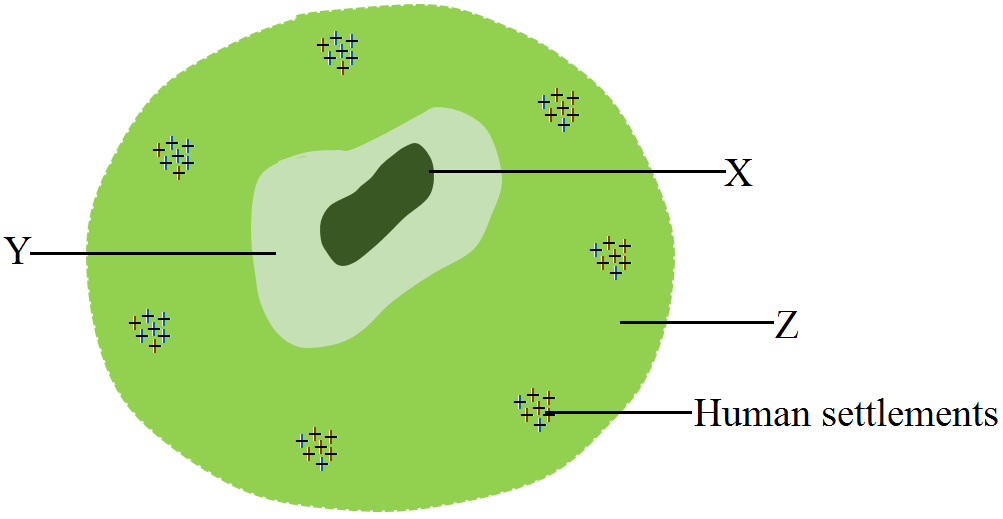
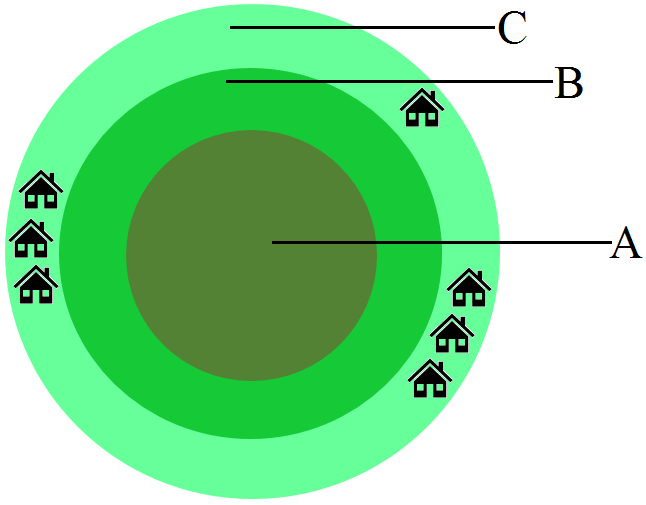
Biosphere reserves are multipurpose protected areas which are meant for preserving genetic diversity in representative ecosystems of various natural biomes and unique biological communities by protecting wild populations, traditional life style of tribals and domesticated plant/animal genetic resources. Each biosphere reserve has three zones-core, buffer and transition zone.

  1. Which of the following is similar to biosphere reserve in terms of conservation?
  1. Gene banks.
  2. Offsite collection.
  3. Orchards.
  4. Hotspots.
  1. Refer to the given figure representing different zones of a biosphere reserve and select the correct option regarding it.

  1. A-Limited human activity is allowed such as for research and education.
  2. B-An active co-operation occurs between reserve management and local people for activities like cropping, settlements, etc.
  3. C-No human activity is allowed.
  4. None of these.
  1. Refer to the given diagrammatic representation of a biosphere reserve.

Select the incorrect statement regarding X, Y and Z.
  1. X is devoted to strict protection of wildlife and no human activity is allowed in this zone.
  2. In Y, only limited human activity (compatible with conservation) is allowed.
  3. In Z, commercial exploitation of natural resources is allowed.
  4. Tourism is allowed in Z zone only.
  5. Zone Y helps to maintain the lifestyle of the tribal people living in the area.
  1. (iii), (iv) and (v) only
  2. (ii), (iii) and (v) only
  3. (i), (iii) and (iv) only
  4. (ii), (iii) and (iv) only
  1. Biosphere reserves differ from national parks and wildlife sanctuaries because in the former.
  1. Human beings are not allowed to enter
  2. People are an integral part of the system
  3. Plants are paid greater attention than the animals
  4. Living organisms are brought from all over the world and preserved for posterity.
  1. MAB Programme means.
  1. Man and biosphere programme.
  2. Man and biodiversity conservation programme.
  3. Manually aided biosphere conservation programme.
  4. None of these.
Read the following text carefully and answer the questions that follow:
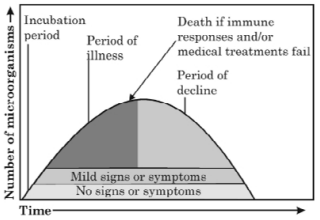
When a microorganism invades a host, a definite sequence of events usually occur leading to infection and disease, causing suffering to the host. This process is called pathogenesis. Once a microorganism overcomes the defense system of the host, development of the disease follows a certain sequence of events as shown in the graph. Study the graph given below for the sequence of events leading to appearance of a disease and answer the questions that follow:
Image
i. In which period, according to the graph there are maximum chances of a person transmitting a disease/infection and why? (1)
ii. Study the graph and write what is an incubation period. Name a sexually transmitted disease that can be easily transmitted during this period. Name the specific type of lymphocytes that are attacked by the pathogen of this disease. (1)
iii. Draw a schematic labelled diagram of an antibody. (2)
OR
In which period, the number of immune cells forming antibodies will be the highest in a person suffering from pneumonia?
Name the immune cells that produce antibodies. (2)
Read the following and answer any four questions from (i) to (v) given below:

The endosperm makes the main source of food for the embryo. Generally the endosperm nucleus divides after the division of the oospore, but in several cases the endosperm is formed to a great extent even before the first division of the oospore. There are three general types of endosperm formation: (a) nuclear type, (b) cellular type and (c) helobial type. The endosperm is usually triploid, but haploid endosperm is also found. Endosperm may either be completely consumed by the developing embryo before seed maturation, or it may persist in the mature seed.

  1. Haploid endosperm is found in:
  1. Pin us.
  2. Cauliflower.
  3. Sunflower.
  4. Pea.
  1. Persistent endosperm is found in:

P. Pea Q. Castor R. Bean S. Coconut T. Groundnut.

  1. Q and S.
  2. P and T.
  3. R, S and T.
  4. P, S and T.
  1. Milk of tender coconut represents (A) and the surrounding white coconut meal represents (B).
S. No
A
B
(a)
Cellular endosperm
Free- nuclear endosperm
(b)
Free-nuclear endosperm
Cellular endosperm
(c)
Helobial endosperm
Cellular endosperm
(d)
Free-nuclear endosperm
Helobial endosperm
  1. If an endosperm cell of a gymnosperm contains 12 chromosomes, the number of chromosomes in each cell of the root will be:
  1. 4
  2. 24
  3. 16
  4. 6
  1. In angiosperms, normally after fertilization:
  1. The zygote divides earlier than the primary endosperm nucleus.
  2. The primary endosperm nucleus divides earlier than the zygote.
  3. Both the zygote and primary endosperm nucleus divide simultaneously.
  4. Both the zygote and primary endosperm nucleus undergo a resting period.
Describe tissue culture.
Write a self-explanatory note on biopatent.
Differentiate between following.
Read the following and answer any four questions from (i) to (v) given below:

Riya studies in 11 standard in a government school. She belongs to a backward family and her parents did not get her properly vaccinated according to immunisation programme. Once while playing in school playground she fell down due to weakness and developed high fever, headache and stiffness in her neck. identify the illness she could be suffering from and answer the following questions.

  1. The microbe responsible for Riya's illness could be.
  1. Vibrio cholerae
  2. Enterovirus
  3. Plasmodium
  4. Mycobacteriurn.
  1. Which vaccine, if administered earlier, would have saved Riya from the illness she unfortunately contracted?
  1. Salk vaccine
  2. MMR vaccine
  3. BCG vaccine
  4. Varicella vaccine
  1. The disease that Riya has contracted spreads through.
  1. Bite of an infected mosquito
  2. Bite of an infected dog
  3. Faecal oral route
  4. Direct contact with the infected person.
  1. Riya can spread her illness to other children through.
  1. Her faeces
  2. Direct contact
  3. Coughing and sneezing in open
  4. Vectors.
  1. Assertion: Polio produces inflammation of the nervous system.

Reason : Stiffness of the neck, paralysis of particular skeletal muscle, is an important symptom of polio.

  1. Both assertion and reason are true, and reason is the correct explanation of assertion.
  2. Both assertion and reason are true, but reason is not the correct explanation of assertion.
  3. Assertion is true, but reason is false.
  4. Both assertion and reason are false.