Question
Describe different types of thermodynamic equilibria.

Answer

SELF

Need a full question paper?

Generate a complete, print-ready paper with questions like this in minutes — across 16+ boards, with answer keys.
Start Generating Free

Similar questions

Write chemical equations for combustion reaction of the following hydrocarbons:
  1. Butane.
  2. Pentene.
  3. Hexyne.
  4. Toluene.
What is conformational isomerism? Explain it with the help of ethane.
What sorts of informations can you draw from the following reaction?
(CN)2(g) + 2OH-(aq) → CN-(aq) + CNO-(aq) + H2O(l)
In any organic compound how will you analyse phosphorus and oxygen? Explain briefly.
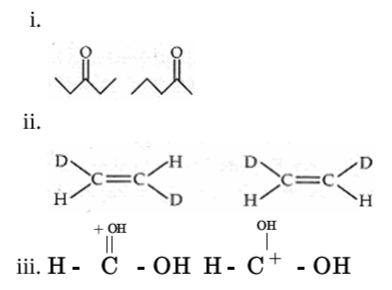
1. What is the relationship between the members of following pairs of structures? Are they structural or geometrical isomers or resonance contributors?
Image
2. A sample of 0.50 g of an organic compound was treated according to Kjeldahl's method. The ammonia evolved was absorbed in 50 mL of $0.5 M H _2 SO _4$. The residual acid required 60 mL of 0.5 M solution of NaOH for neutralisation. Find the percentage composition of nitrogen in the compound.
Determine the solubilities of silver chromate, barium chromate, ferric hydroxide, lead chloride and mercurous iodide at 298 K from their solubility product constants given in Table 6.9. Determine also the molarities of individual ions.
An alkene 'A' on ozonolysis gives a mixture of ethanal and pentan-3-one. Write structure and IUPAC name of 'A'.
At 700K, equilibrium constant for the reaction:
$\text{H}_2\text{ (g) + I}_2\text{ (g)}\rightleftharpoons2\text{HI (g)}$ is 54.8. If 0.5 mol L–1 of HI(g) is present at equilibrium at 700K, what are the concentration of H2(g) and I2(g) assuming that we initially started with HI(g) and allowed it to reach equilibrium at 700K?
Match the species in Column I with the type of hybrid orbitals in Column II.
 
Column I
 
Column II
i.
NO
a.
1.5
ii.
CO
b.
2.0
iii.
$\text{O}^{-}_{2}$
c.
2.5
iv.
O2
d.
3.0
Sulphuric acid reacts with sodium hydroxide as follows:
H2SO4 + 2NaOH Na2SO4 + 2H2O
When 1 L of 0.1 M sulphuric acid solution is allowed to react with 1 L of 0.1 M sodium hydroxide solution. Calculate the amount of sodium sulphate formed and its molarity in the solution obtained.