Question
Describe electrolysis of aqueous NaCl.

Answer

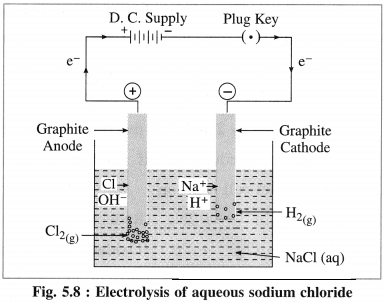
(1) Construction of an electrolytic cell : It consists of a vessel containing aqueous solution of NaCl. Two inert electrodes (graphite electrodes) are dipped in it and connected to an external source of electricity like battery. The electrode connected to the negative terminal is a cathode and that connected to a positive terminal is an anode.

(2) Working of the cell :
(A) $NaCl _{( aq )}$ and $H _2 O _{( l )}$ dissociate as follows :
$\begin{aligned}
& NaCl _{( aq )} \rightarrow Na _{( aq )}^{+}+ Cl _{( aq )}^{-} \\
& H _2 O _{( l )} \rightleftharpoons H _{( aq )}^{+}+ OH _{( aq )}^{-} \text {(Partially) }
\end{aligned}$
Image

(3) Reactions in electrolytic cell :
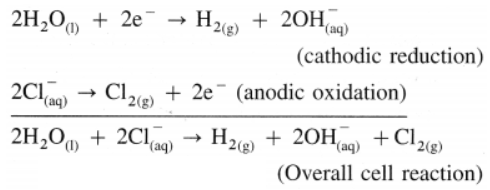
(i) Reduction half reaction at cathode : There are $Na ^{+}$and $H ^{+}$ions but since $H ^{+}$are more reducible than $Na ^{+}$, they undergo reduction liberating hydrogen and $Na ^{+}$are left in the solution.
$\begin{aligned}
& 2 H _2 O _{( l )}+2 e ^{-} \rightarrow H _{2( g )}+2 OH _{( aq )}^{-} \text {(reduction) } \\& E ^0=-0.83 V
\end{aligned}$

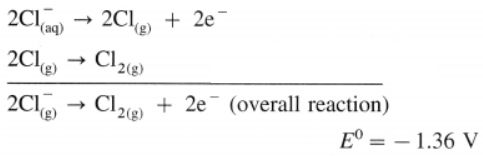
(ii) Oxidation half reaction at anode : At anode there are $Cl ^{-}$and $OH ^{-}$. But $Cl ^{-}$ions are preferably oxidised due to less decomposition potential.
Image
Net cell reaction: Since two electrons are gained at cathode and two electrons are released at anode for each redox step, the electrical neutrality is maintained. Hence we can write,
Image

Since $Na ^{+}$and $OH ^{-}$are left in the solution, they form $NaOH _{( aq )}$.

(4) Results of electrolysis :
  • $H _2$ gas is liberated at cathode.
  • $Cl _2$ gas is liberated at anode.
  • $NaOH$ is formed in the solution and it reacts basic.

Need a full question paper?

Generate a complete, print-ready paper with questions like this in minutes — across 16+ boards, with answer keys.
Start Generating Free