Question
Describe female reproductive system of human
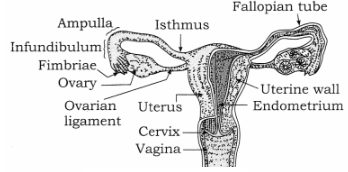
The female reproductive system consists of internal organs and external genitalia.
Internal organs are pair of ovaries and pair of fallopian ducts or oviducts, single median uterus and vagina. External genitalia is called vulva. There are a pair of vestibular glands in external genitalia. Mammary glands or breasts are also associated with reproductive system of female.
(1) Ovaries:
(2) Fallopian tubes/oviducts:
(i) Fallopian tubes lie horizontally over peritoneal cavity. These are about 10 to 12 cm long, narrow, muscular structure lined by ciliated epithelium.
(ii) They transport the ovum after ovulation from the ovary to the uterus.
(iii) Fallopian tube can be subdivided into the following three parts:
(3) Uterus/Womb:
(i) Uterus is a pear-shaped, highly muscular, thick walled, hollow organ measuring about 8 cm in length, 5 cm in width and 2 cm in thickness.
(ii) Uterus has the following three parts : Fundus, Body or corpus and Cervix.
(iii) The cervix communicates above with the body of the uterus by an aperture, the internal os and with vagina below by an opening the external os.
(iv) Uterus has three-layered wall. These layers are:
(v) Uterus receives the ovum from fallopian tube. It develops placenta during pregnancy for the nourishment of foetus. At the time of parturition, it expels the young one at birth.
(4) Vagina:
(5) External genitalia or vulva or pudendum : The external genitalia consists of five parts; viz. labia majora, labia minora, mons veneris, clitoris and vestibule.
(6) A pair of vestibular glands / Bartholin’s glands : These glands open into the vestibule and release a lubricating fluid.
(7) A pair of mammary glands/breasts : These are the accessory organs of female reproductive system for production and release of milk after parturition.
Generate a complete, print-ready paper with questions like this in minutes — across 16+ boards, with answer keys.
