Question
Describe female reproductive system.

Answer

The primary function of the female reproductive system is to produce the female egg cells which are essential for reproduction These are called as the ova or oocytes. It is important to know that, the entire system is designed for transporting the ova to the exact fertilization site. Further, the fertilization process of an egg after interaction with sperm usually happens in the fallopian tubes.

The later phase of the fertilized egg is associated with getting rooted into the uterus walls. This is counted as the beginning of the early stages of pregnancy. In case fertilization or implantation doesn’t occur, then the system is aimed to menstruate. Moreover, the female reproductive system is responsible for producing female sex hormones which maintain the reproductive cycle.
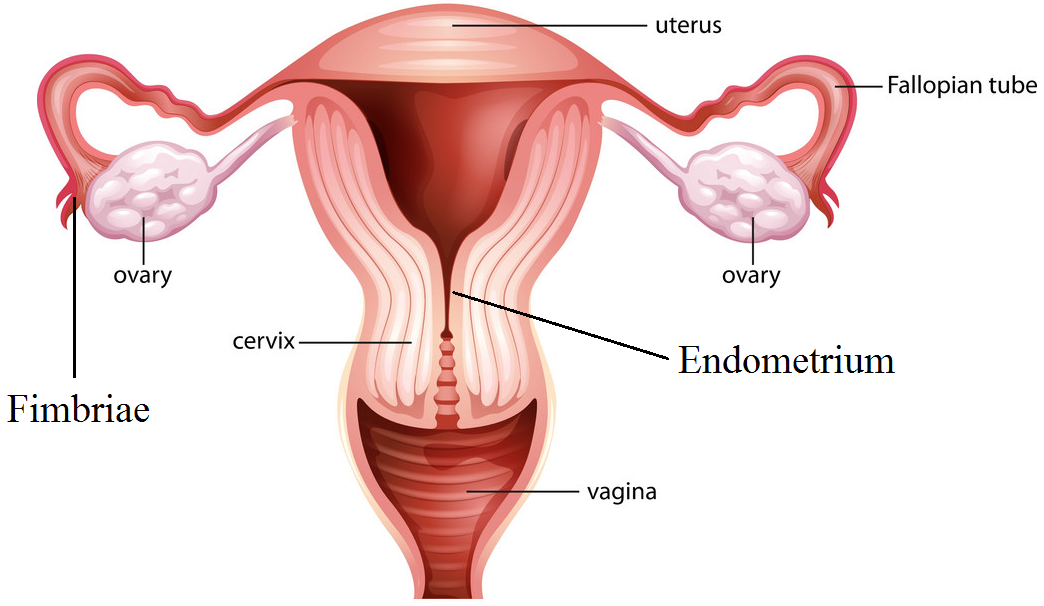
Parts of Female Reproductive System

The female reproductive system comprises of parts which are both internal and external to the body.

  1. External Reproductive Parts:

The external parts of the female reproductive system include:

  • Labia majora: It protects and encloses the other outside reproductive organ. The labia majora can be tagged as outsized and fleshy and is analogous to the male scrotum. It contains sweat as well as oil-secreting glands. The labia majora gets covered with hair right after puberty.

  • Labia minora: These are translated as ‘small lips’, and can be quite small close to 2 inches wide. Labia minora rest just in the interior of labia majora. It surrounds the primary opening of the vagina and urethra.

  • Bartholin’s glands: The location of these glands rest beside the vaginal opening and is responsible to manage a fluid discharge.

  • Clitoris: Both the labia minora encounter at the clitoris, which is a small and delicate protrusion that is analogous to the penis in the male reproductive system. This part of the female reproductive system is covered by a skin fold, termed as prepuce. Similar to the male penis, the clitoris is sensitive to stimulus and can turn erect.

  1. Internal Reproductive Parts:

The internal parts of the female reproductive system include:

  • Vagina: It is a canal which joins the cervix to the external portion of the body. You can even call it as the birth canal.

  • Womb or Uterus: It is a pear-shaped, hollow organ which is ‘home’ for a developing fetus. Further, the uterus separates into two parts; namely, the cervix, and the corpus. The corpus easily enlarges for holding a developing baby.

  • Ovaries: These are oval-shaped glands which are small and are located on both side of the uterus. Ovaries produce harmones and eggs.

  • Fallopian tubes: They are narrow tubes which attach to the upper portion of the uterus. Fallopian tubes act as tunnels for the egg cells. Therefore, they transport the egg cells from the ovaries the to uterus.
Need a full question paper?

Generate a complete, print-ready paper with questions like this in minutes — across 16+ boards, with answer keys.

Start Generating Free

Similar questions

What role does pituitary gonadotropins play during follicular and ovulatory phases of menstrual cycle and also explain the shift in steroidal secretions.
  1. Explain the role of regulatory gene, operator, promoter and structural genes in lac operon when E.coli is growing in a culture medium with the source of energy as lactose.
  2. Mention what would happen if lactose is withdrawn from the culture medium.
Answer the following questions:
State and explain the law of dominance as proposed by Mendel.
What is Hardy-Weinberg principle? Discuss with suitable example.
Answer the following questions:
Draw a diagram of a mature human male gamete. Label the following parts: Acrosome, nucleus, middle piece and tail.
Describe in detail the multiple allelism by the help of inheritance of human blood group.
Two heterozygous parents are crossed. If the two loci are linked what would be the distribution of phenotypic features in F1 generation for a dibybrid cross?
Read the following and answer any four questions from (i) to (v) given below:

Transgenic animals can serve as factories that in some cases, may produce large amount of proteins more efficiently. Transgenic mice have been engineered to express human antibodies by introducing large segment of human DNA encoding human immunoglobulin genes. In transgenic large animals such as cow or sheep proteins of pharmaceutical value can be produced in large quantities in milk which is later purified. Transgenesis can be used to alter many phenotypic properties including growth rate, fat composition, milk production, hair texture, etc.

  1. The production of transgenic animals includes
  1. Identification and separation of desired gene.
  2. Combining the desired gene with appropriate vector.
  3. Introduction of vector in cells, tissues or embryos.
  4. All of these.
  1. In transgenic animals, i.e., cow and sheep proteins of pharmaceutical value are produced in large quantities in the
  1. Blood.
  2. Accumulated fat.
  3. Mammary glands.
  4. None of these.
  1. Mouse is mostly preferred animal for studies on gene transfer because.
  1.  Short oestrous cycle.
  2. Long gestation period.
  3. Short generation time.
  4. Production of one or two offspring per pregnancy.
  1. Both (A) and (C)
  2. Both (A) and (B)
  3. Only D
  4. Both (C) and (D).
  1. Transgenic genes alter many phenotypic properties including:
  1. Growth rate.
  2. Fat composition.
  3. Milk production.
  4. All of these.
  1. Assertion: Transgenic mice have been engineered to express human antibodies.

Reason: Large segment of human DNA encoding human immunoglobulin have been transferred to mice.

  1. Both assertion and reason are true and reason is the correct explanation of assertion.
  2. Both assertion and reason are true but reason is not the correct explanation of assertion.
  3. Assertion is true but reason is false.
  4. Both assertion and reason are false.
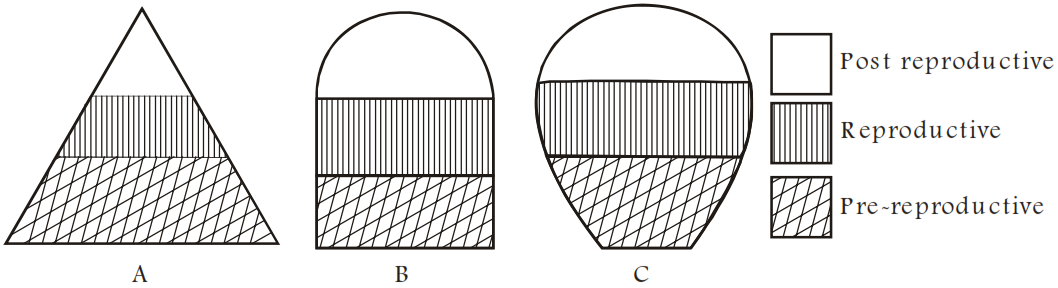
The following diagrams are the age pyramids of different populations. Comment on the status of these populations.

Mention their source and the function they perform:
hCG, LH, FSH, Relaxin.