Question
Describe: Genetic engineered insulin

Answer

→ Insulin is produced by beta cells of pancreas.
→ Insulin plays important role in a sugar or carbohydrate metabolism.
→ Due to lack of insulin diabetes mellitus occurs in humans.
→ Insulin used for diabetes was earlier extracted from pancreas of slaughtered cattle and pigs.
→ Insulin from an animal source, though caused some patients to develop allergy or other types of reactions to the foreign protein.
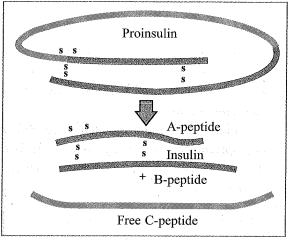
Image
→ Insulin consists of two short polypeptide chains: chain A and chain B.
→ Polypeptide Chain A contains 21 amino acids and chain B contains 30 amino acids that are linked together by disulphide bridges.
→ In mammals, including humans, insulin is synthesised as a pro-hormone (like a pro-enzyme, the pro-hormone also needs to be processed before it becomes a fully mature and functional hormone) which contains an extra stretch called the C peptide.
→ This C peptide is not present in the mature insulin and is removed during maturation into insulin.
→ The main challenge for production of insulin using rDNA techniques was getting insulin assembled into a mature form.
→ In 1983, Eli Lilly an American company prepared two DNA sequences corresponding to A and B, chains of human insulin and introduced them in plasmids of E. coli to produce insulin chains.
→ Chains A and B were produced separately, extracted and combined by creating disulfide bonds to form human insulin.
Need a full question paper?

Generate a complete, print-ready paper with questions like this in minutes — across 16+ boards, with answer keys.

Start Generating Free

Similar questions

Read the following and answer any four questions from (i) to (v) given below:

Alcohols are important industrial solvents. Ethanol, methanol, propanol and butanol are produced commercially by fermentation activity of some fungi, majorly yeasts. During fermentation, yeast cells convert cereal derived sugars into ethanol and CO2 At the same time hundreds of secondary metabolites that influence the aroma and taste of alcohol are produced. Sugar concentration affects the rate of fermentation reactions. Yeast cannot grow in very strong sugar solution. In case of complex carbohydrate containing nutrient media, 1% malt or Rhizopus is used along with yeasts. Hydrolysis of starch is carried out at high temperature for 30 ruins. 'Tile crushed food mixed with hot water for obtaining malt in called mash. 'Tile nutrient medium prior to fermentation in called wort. Wort is cooled down to appropriate temperature and inoculated with strain of yeast.

  1. Tile rate of alcohol production is measured on the basis of:
  1. Amount of sugar present in the medium.
  2. Amount of CO2 produced per unit time.
  3. Amount of yeast added in the medium.
  4. All of these.
  1. A number of chemicals are produced at the time of alcoholic fermentation with the change of nutrient media, pH and aeration. Select such by-product from the following.
  1. Phenylethanol.
  2. Amyl alcohol.
  3. Glycerol.
  4. All of these.
  1. During alcoholic fermentation of cereals and potato, the crushed food mixed with hot water for obtaining malt is called:
  1. Juice.
  2. Mash.
  3. Wort.
  4. None of these.
  1. Distilled alcohol with 95% ethanol content is called:
  1. Absolute alcohol.
  2. Rectified spirit.
  3. Gin.
  4. Brandy.
  1. Assertion: Rhizopus or 1% malt is used in the nutrient medium when it contains complex carbohydrates.

Reason: Yeast does not possess sufficient diastase or amylase. 

  1. Both assertion and reason are true and reason is the correct explanation of assertion.
  2. Both assertion and reason are true but reason is not the correct explanation of assertion.
  3. Assertion is true but reason is false.
  4. Both assertion and reason are false.
Read the following and answer any four questions from (i) to (v) given below:

Embryo develops at the micropylar end of the embryo sac, where the zygote is situated. Most zygotes divided only after certain amount of endosperm is formed. The early stages of embryo development are similar in both monocotyledons and dicotyledons. The zygote gives rise to the proembryo and subsequently to the globular heart-shaped and mature embryo. A typical dicotyledonous embryo consists of an embryonal axis and two cotyledons. Embryo of monocotyledons possess only one cotyledon.

  1. True embryo develops as a result of fusion of:
  1. Two polar nuclei of embryo sac.
  2. An egg cell and a male gamete.
  3. Synergid and male gamete.
  4. A male gamete and antipodals.
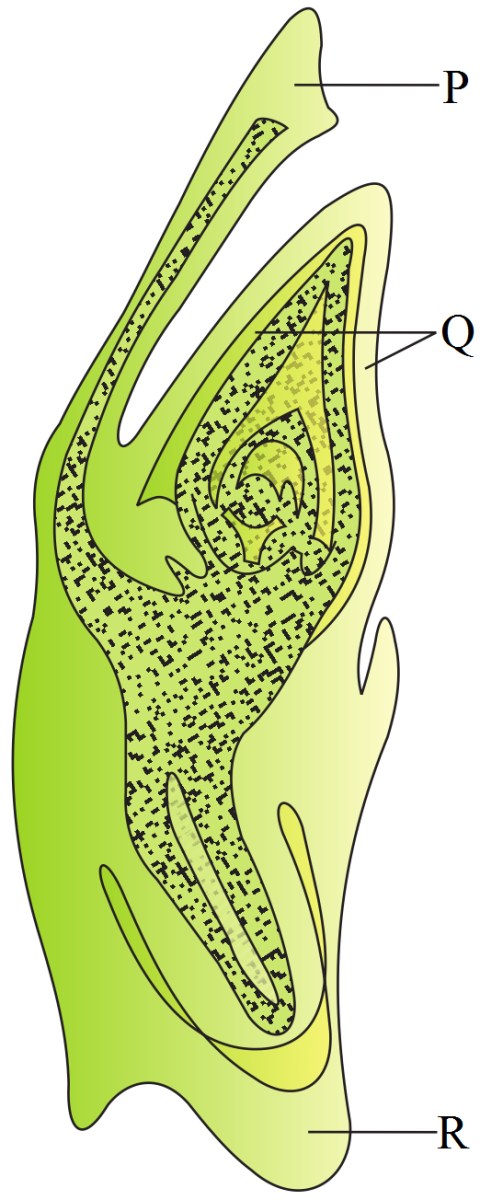
  1. Refer to the given diagram of the embryo of an angiospermous plant with parts labelled P, Q and R. Select the correct statement(s) regarding this.

  1. Part 'P' supplies nutrition to the developing embryo.
  2. Part 'Q' is the protective sheath of radicle and root cap.
  3. Part 'R' is the protective sheath of shoot apex and leaf primordia.
  4. The embryo shown in the diagram is present in members of Family Poaceae.
  1. (IV) only.
  2. (II) and (III) only.
  3. (I) and (IV) only.
  4. (I), (II), (III) and (IV).
  1. Which of the given statements are true?
  1. During the development of a dicot embryo, heart-shaped embryo is followed by globular embryo.
  2. The part of embryonal axis above the level of cotyledons is epicotyl, while the part below the level of cotyledons is hypocotyl.
  3. Monocot seeds possess a single cotyledon, represented by scutellum.
  1. (I) and (II).
  2. (II) and (III).
  3. (I) and (III).
  4. (I), (II) and (III).
  1. Consider the following parts of an embryonal axis of a dicot seed.
  1. Hypocotyl.
  2. Epicotyl.
  3. Radicle.
  4. Plumule.

In which of the following the above parts are correctly arranged from top to base?

  1. (III) → (I) → (II) → (IV).
  2. (II) → (I) → (III) → (IV).
  3. (IV) → (II) → (I) → (III).
  4. (III) → (IV) → (II) → (I).
  1. In grass family, the cotyledon, is called:
  1. Epiblast.
  2. Plumule.
  3. Scutellum.
  4. Perisperm.
Read the following and answer any four questions from (i) to (v) given below:

Kangaroo rat seldom drinks water. It has thick coat to minimise evaporative desiccation. TI1e animal seldom comes out of its comparatively humid and cool burrow during the day time. 90% of its water requirement is met from metabolic water (water produced by respiratory breakdown of fats) while 10% is obtained from its food. Loss of water is minimised by producing nearly solid urine and faeces. As the animal faces acute water scarcity, it develops two types of adaptations : reducing water loss and ability to tolerate desert conditions.

  1. Kangaroo rat is a:
  1. Partial regulators
  2. Partial conformer
  3. Regulator
  4. Conformer
  1. Metabolic water refers to:
  1. Water required for metabolic activities.
  2. Water present in intercellular fluid.
  3. Water produced during oxidation of fat or carbohydrate.
  4. Water taken in, to promote metabolism.
  1. Desert animals minimise water loss by:
  1. Producing highly concentrated urine.
  2. Promoting maximum reabsorption of water in kidney tubules.
  3. Possessing one of the longest loop of Henle in kidney tubules.
  4. All of these.
  1. Assertion: Kangaroo rat can tolerate and thrive in wide temperature range and is known as stenothermal.

Reason: Kangaroo rats go into hibernation during winter to escape cold weather.

  1. Both assertion and reason are true and reason is the correct explanation of assertion.
  2. Both assertion and reason are true but reason is not the correct explanation of assertion.
  3. Assertion is true but reason is false.
  4. Both assertion and reason are false.
  1. The adaptations in an organism are meant for:
  1. Optimum primary production.
  2. Optimum life span.
  3. Optimum mobility.
  4. Optimum survival and reproduction.
Bacteria cannot be seen with the naked eyes, but these can be seen with the help of a microscope. If you have to carry a sample from your home to your biology laboratory to demonstrate the presence of microbes with the help of a microscope, which sample would you carry and why?
Explain: Acquired Immunity.
Describe the process of DNA Fingerprinting in detail.
Suggest some methods to assist infertile couples to have children.
Explain Mutualism as a population interaction with suitable examples.###Explain Mutualism with examples
Read the following text carefully and answer the questions that follow:
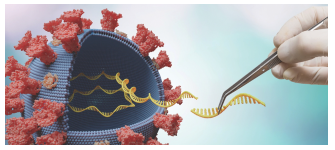
A pathogen is defined as an organism causing disease to its host, with the severity of the disease symptoms referred to as virulence. Pathogens are taxonomically widely diverse and comprise viruses and bacteria as well as unicellular and multicellular eukaryotes. The immune system of a person is suppressed. He was found positive for a pathogen in the diagnostic test ELISA.
Image
i. Name the disease, the patient is suffering from. (1)
ii. Which pathogen is identified by ELISA test? (1)
iii. Which cells of the body are attacked by the pathogen? (2)
OR
Suggest preventive measures of the infection. (2)
Read the following text carefully and answer the questions that follow:
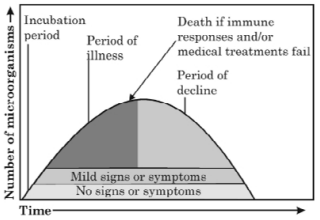
When a microorganism invades a host, a definite sequence of events usually occur leading to infection and disease, causing suffering to the host. This process is called pathogenesis. Once a microorganism overcomes the defense system of the host, development of the disease follows a certain sequence of events as shown in the graph. Study the graph given below for the sequence of events leading to appearance of a disease and answer the questions that follow:
Image
i. In which period, according to the graph there are maximum chances of a person transmitting a disease/infection and why? (1)
ii. Study the graph and write what is an incubation period. Name a sexually transmitted disease that can be easily transmitted during this period. Name the specific type of lymphocytes that are attacked by the pathogen of this disease. (1)
iii. Draw a schematic labelled diagram of an antibody. (2)
OR
In which period, the number of immune cells forming antibodies will be the highest in a person suffering from pneumonia?
Name the immune cells that produce antibodies. (2)