Question
Describe in brief the structure of thoracic cage.

Answer

Thoracic cage consists of 12 pairs of ribs, breast bone or sternum.

i. Ribs:

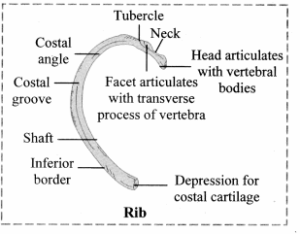
1. A rib is a ‘C’ shaped bone. It is attached to respective thoracic vertebrae on dorsal side.
2. Twelve pairs of ribs are attached to twelve thoracic vertebrae. For attachment to the vertebrae the posterior ends of ribs have two protuberances namely the head and tubercle.
3. The head of rib attaches to facet formed by demifacets of adjacent thoracic vertebrae at the base of transverse processes.

Image
4. The tip of transverse processes of these vertebrae also have facets for attachment of ribs where tubercles of ribs are attached.
5. Ribs provide space for attachment of intercostal muscles.
6. On ventral side, the ribs may or may not attach the sternum. Depending on their attachment, the ribs are classified into three types:
  1. True ribs: First seven pairs of ribs are attached directly to the sternum by means of their costal cartilages.
  2. False ribs: Costal cartilages of rib numbers 8, 9 and 10 are attached to rib number 7 on either side and not directly to the sternum. Hence, these are called false ribs.
  3. Floating ribs: Last two pairs of ribs have no ventral connection. Hence, they are called floating ribs.
ii. Sternum:

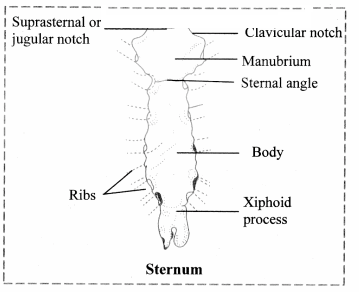
1.It is a flat, narrow bone, around 15 cms in length.
Image
2.It is placed medially in anterior thoracic ] jugular notch wall (chest region).
3.It consists of three distinct parts – manubrium, body and xiphoid processes.
4.Manubrium shows two notches on anterio-lateral side for attachment with clavicle of each side. It also sows two notches on each of the lateral side for attachment of first two pairs of ribs.
5.Body of sternum is a flat bone that shows five notches on lateral aspect which are meant for direct or indirect attachment of ribs.
6.Xiphoid process is lowermost part of sternum which is initially cartilaginous and gets ossified in adults. It provides space for the attachment of diaphragm and abdominal muscles.
7.Ribs are attached to sternum by means of cartilaginous extensions called costal cartilages.

Need a full question paper?

Generate a complete, print-ready paper with questions like this in minutes — across 16+ boards, with answer keys.
Start Generating Free