Question
Describe reflex action.

Answer

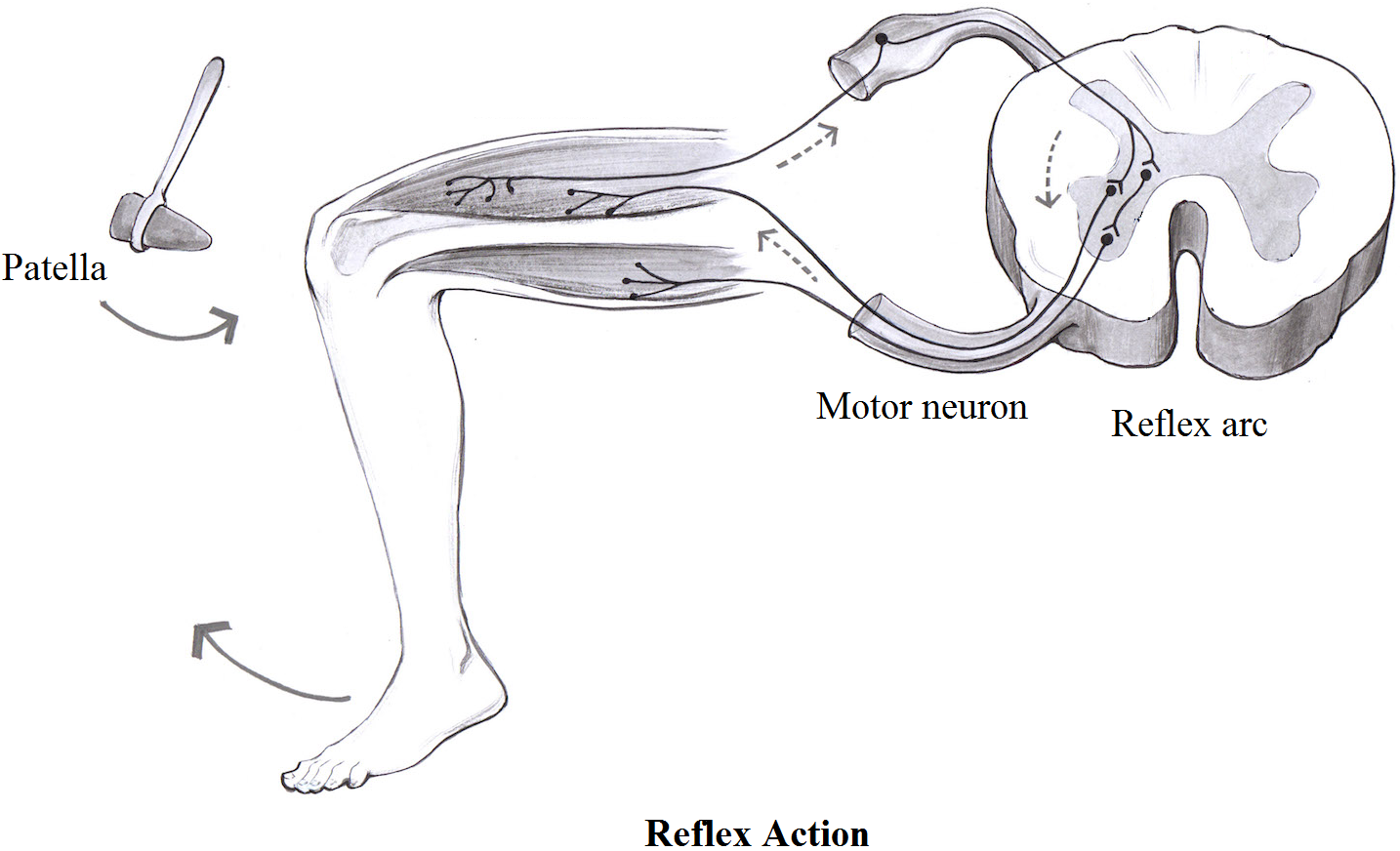
The entire process of response to a peripheral neural stimulation, that occurs involuntarily, i.e., without conscious effort or thought and requires the involvment of a part of the central neural system is called a reflex action.
The reflex pathway comprises at least one afferent neuron (receptor) and one efferent effector or excitor neuron appropriately arranged in a series. The afferent neuron receives signal from a sensory organ and transmits the impulse via a dorsal nerve root into the CNS (at the level of spinal cord). The efferent nueuron then carries signals from CNS to the effector. The stimulus and response thus forms a reflex arc as shown below in the knee jerk reflex.

Need a full question paper?

Generate a complete, print-ready paper with questions like this in minutes — across 16+ boards, with answer keys.
Start Generating Free

Similar questions

Explain the association of carbohydrate to the plasma membrane and its significance.
Explain the basic structure of an Amino acid.
What are the peculiar features that you find in parasitic platyhelminthes?
Sunday morning Abhishek and his friends emptied all the overhead tanks belonging to flat owners who were not residing in their apartments for the last few months. On their return, the owners complained about their empty tanks. Some elderly people even spoke against Abhishek and his friends. Abhishek humbly apologised for the inconvenience caused.
He explained that water in the tanks had become stagnant and become a breeding ground for mosquitoes which will give rise to malaria. The people appreciated the boys.
  1. What values are reflected by Abhishek in the above case?
  2. What is the causal agent of malaria and how does it reach human body?
  3. How many phases the causal organism undergoes in its life cycle?
  4. As an individual what can you do to avoid malaria in your neighbourhood?
Discuss the types of enzyme cofactors that are required for the efficient activity of enzymes.
It is always taught by our teachers and parents that we should not eat food or fruits without washing our hands as it contains thousands of germs and pathogens which we cannot see with our naked eyes.
  1. What are germs?
  2. What are the basic difference between the unicellular and multicellular organisms?
  3. Name the instrument that allow us to study the unicellular organisms.
  4. What values are taught by our teachers and parents?
What is the difference between florigen and other plant growth hormones?
Draw a labelled diagram showing reabsorption and secretion of major substances at different partsof the nephron.
In botanical gardens and tea gardens, gardeners trim the plants regularly so that they remain bushy. Does this practice have any scientific explanation?
Why does the interior of bacterial cell appear simple and granular? Which components make cell envelope of bacterial cell? What gives gummy or sticky trait to bacterial cells and if it is not essential for survival, what are its functions?