Question
Describe spherical aberration for spherical lenses. What are different ways to minimize or eliminate it?

Answer

i. All the formulae used for image formation by lenses are based on some assumption. However, in reality these assumptions are not always true.ii. A single point focus in case of lenses is possible only for small aperture spherical lenses and for paraxial rays.
iii. The rays coming from a distant object farther from principal axis no longer remain parallel to the axis. Thus, the focus gradually shifts towards pole.
iv. This defect arises due to spherical shape of the refracting surface, hence known as spherical aberration. It results into a blurred image with unclear boundaries.


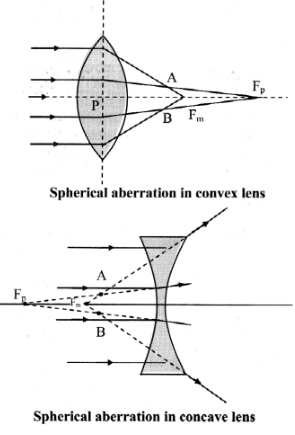
Image
v. As shown in figure, the rays near the edge of the lens converge at focal point $F_M$. Whereas, the rays near the principal axis converge at point $F_P$​​​​​​​. The distance between $F_M$​​​​​​​ and $F_P​​​​​​​$​​​​​​​ is measured as the longitudinal spherical aberration.
vi. In absence of this aberration, a single point image can be obtained on a screen. In the presence of spherical aberration, the image is always a circle.
vii. At a particular location of the screen (across AB in figure), the diameter of this circle is minimum. This is called the circle of least confusion. Radius of this circle is transverse spherical aberration.
Methods to eliminate/reduce spherical aberration in lenses:
i. Cheapest method to reduce the spherical aberration is to use a planoconvex or planoconcave lens with curved side facing the incident rays.
ii. Certain ratio of radii of curvature for a given refractive index almost eliminates the spherical aberration. For $n = 1.5$, the ratio is
$\frac{R_1}{R_2}=\frac{1}{6}$ and for $n =2, \frac{R_1}{R_2}=\frac{1}{5}$
iii. Use of two thin converging lenses separated by distance equal to difference between their focal lengths with lens of larger focal length facing the incident rays considerably reduces spherical aberration.
iv. Spherical aberration of a convex lens is positive (for real image), while that of a concave lens is negative. Thus, a suitable combination of them can completely eliminate spherical aberration.

Need a full question paper?

Generate a complete, print-ready paper with questions like this in minutes — across 16+ boards, with answer keys.
Start Generating Free

Similar questions

Find the value of resistances for the following colour code.
i. Blue Green Red Gold
ii. Brown Black Red Silver
iii. Red Red Orange Gold
iv. Orange White Red Gold
v. Yellow Violet Brown Silver
(i) State the conditions under which a rainbow can be seen.
(ii) Explain the formation of a primary rainbow. For which angular range with the horizontal is it visible?
(iii) Explain the formation of a secondary rainbow. For which angular range with the horizontal is it visible?
(iv) Is it possible to see primary and secondary rainbow simultaneously? Under what conditions?
What are some properties of magnetic lines of force?
Define time period of a satellite.
Obtain an expression for the period of a satellite in a circular orbit round the Earth. Show that the square of the period of revolution of a satellite is directly proportional to the cube of the orbital radius.
A book with many printing errors contains four different formulae for the displacement $y$ of a particle undergoing a certain periodic function:
$i) \ y = a \sin \frac{2 \pi t}{T}$
$ii) \ y=a \sin v t$
$iii) \ y=\frac{a}{T} \sin \frac{t}{a}$
$iv) \  y =\frac{a}{\sqrt{2}}\left[\sin \frac{2 \pi t}{T}+\cos \frac{2 \pi t}{T}\right]$
Here, $a$ is maximum displacement of particle, $y$ is speed of particle, $T$ is time period of motion. Rule out the wrong formulae on dimensional grounds.
A magnetic pole of bar magnet with pole strength of $100\  Am$ is $20\ cm$ away from the centre of a bar magnet. Bar magnet has pole strength of $200\ Am$ and has a length $5\ cm$. If the magnetic pole is on the axis of the bar magnet, find the force on the magnetic pole.
Discuss the following as special cases of elastic collisions and obtain their exact or approximate final velocities in terms
of their initial velocities.
(i) Colliding bodies are identical.
(ii) A very heavy object collides on a lighter object, initially at rest.
(iii) A very light object collides on a comparatively much massive object, initially at rest.
Distinguish between elastic and inelastic collision.
State Newton’s formula for velocity of sound.
$\overrightarrow{ P }=\hat{ i }+ 2 \hat{ k }$ and $\overrightarrow{ Q }=2 \hat{ i }+\hat{ j }-2 \hat{ k }$ are two vectors, find the unit vector parallel to $\overrightarrow{ P } \times \overrightarrow{ Q }$ Also find the vector perpendicular to $P$ and $Q$ of magnitude 6 units.