Question
Describe the basic characteristics of a photosystem and explain how photosystem I differs from photosystem II.

Answer

  • Photosystems are the discrete units of organisation of the pigments in the thylakoid (grana) membranes.
  • Each photosystem has about 250-400 pigment molecules, which include chlorophyll a, that forms the reaction centre and other accessory pigments, chlorophyll b, carotene and xanthophyll, forming the antenna of light harvesting complex (LHC).
  • Chlorophyll a that forms reaction centre has two absorption maxima, at 680 nm and 700 nm; these pigments are designated as $P_{680}$ and $P_{700}$.
  •  
PS I
PS II
It is constituted by those chlorophyll $P_{700}$ and other pigment molecules which absorb light energy and pass on to $P_{700}$.
It is constituted by those chlorophyll $P_{680}$ and accessory pigments that pass on light energy to $P_{680}$.
The reaction centre is $P_{700}$
The reaction centre is $P_{680}$
The electrons emitted by this come back as de-energized electrons.
The electrons emitted by this do not come back, but are replaced by electrons generated by photolysis of water.
It is involved only in non-cyclic photophosphorylation.
It is involved both in cyclic and non-cyclic photophosphorylation.

Need a full question paper?

Generate a complete, print-ready paper with questions like this in minutes — across 16+ boards, with answer keys.
Start Generating Free

Similar questions

What is the importance of taxonomical aids? Describe various taxonomical aids.
What are hormones? Explain the mechanism of hormone action with the help of a diagram.
Describe circulatory pathways in animals.
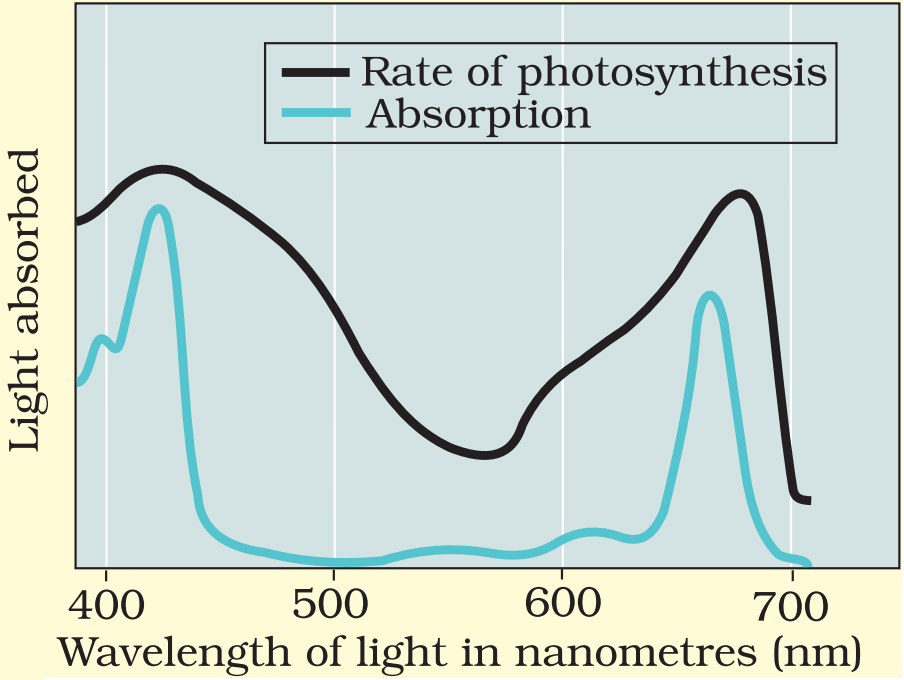
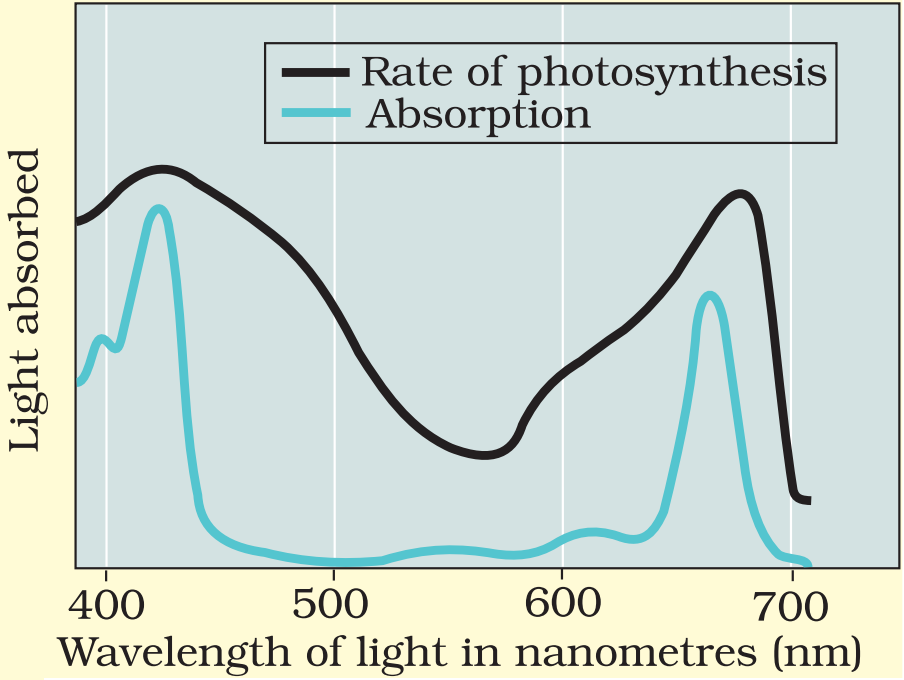
In the figure given below, the black line (upper) indicates action spectrum for photosynthesis and the lighter line (lower) indicates the absorption spectrum of chlorophyll a, answer the following:
  1. What does the action spectrum indicate? How can we plot an action spectrum? Explain with an example.
  2. How can we derive an absorption spectrum for any substance?
  3. If chlorophyll a is responsible for light reaction of photosynthesis, why do the action spectrum and absorption spectrum not overlap?
Complete the following table by filling the blanks marked (A-F) below.
Essential element
Macro or Micro/ Region of requirement
Function
Dificiency
Boron
Micro/ apical leaves and seeds
Elongation of pollen tube
____ (A) ____
____ (B) ____
Micro/ whole plant
Involved in OXi-red reactions
Development of necrotic spots
Phosphorus
____ (C) ____
____ (D) ____
Structed plants
Magnesium
Macro/ growing areas of root and stems
____ (E) ____
____ (F) ____
Give a tabular representation of respiratory balance sheet.
Write differences between plant cell and animal cell.
What is a tissue? Describe different types of simple tissues in plants.
Explain the process of secondary growth in the stems of woody angiosperms with the help of schematic diagrams. What is its significance?
Give the biochemical composition of plasma membrane. How are lipid molecules arranged in the membrane?