Question
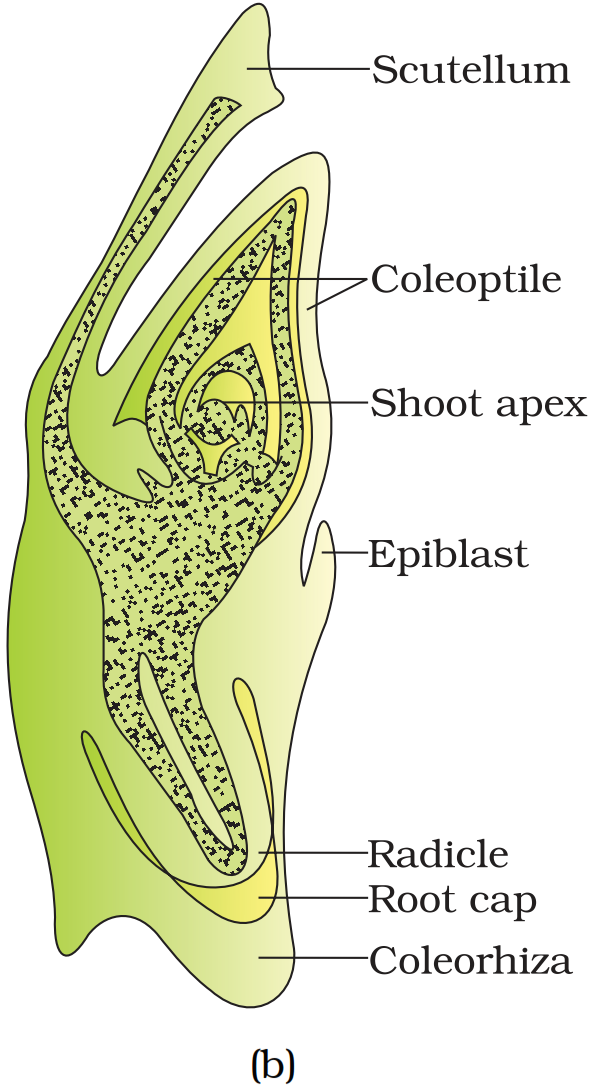
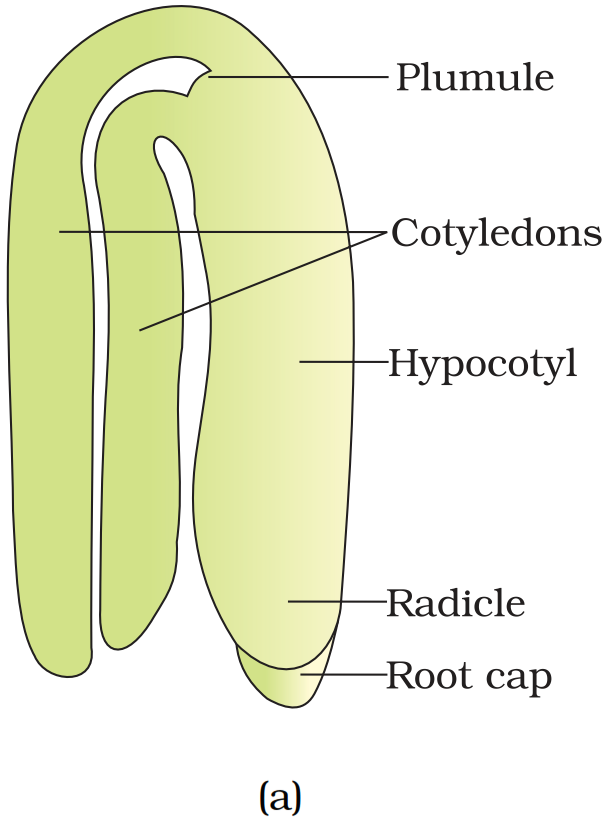
Describe the difference between the structures of a dicot embryo and monocot embryo. Also draw LS of monocot and dicot seeds.

Answer

Difference between the structures of a dicot embryo and monocot embryo:

S. No.
DICOT EMBRYO
MONOCOT EMBRYO
1.
Dicot embryo is enclosed in between two cotyledons.
Monocot embryo is enclosed by a single cotyledon.
2.
Dicot embryo has its plumule, future shoot in distal position.
Monocot embryo has its plumule in lateral position.
3.
Dicot embryo has no protective sheaths on the plumule and radicle.
Monocot embryo has protective sheaths called as coleoptile covering the plumule and coleorrhiza covering the radicle.
4.
Dicot embryo has no scutellum.
Monocot embryo has a scutellum.
5.
Dicot embryo mostly does not have an endosperm to nourish it.
Monocot embryo has an endosperm to nourish the embryo.

Diagram LS of monocot and dicot seeds:
Need a full question paper?

Generate a complete, print-ready paper with questions like this in minutes — across 16+ boards, with answer keys.

Start Generating Free

Similar questions

Using a flow chart explain the process of decomposition. List the factors which affect this process.
  1. Distinguish between parasitism and predation, with an example of each.
  2. Name two groups of animals, that are regulaters.
  3. When does the growth curve assume of J shape?
During the course of evolution why DNA was chosen over RNA as genetic material? Give reasons by first discussing the desired criteria in a molecule that can act as genetic material and in the light of biochemical differences between DNA and RNA.
Answer the following questions:
Explain the events that occur in a graafian follicle at the time of ovulation and thereafter.
The following is the illustration of the sequence of ovarian events (a – i) in a human female.

Identify the figure that illustrates ovulation and mention the stage of oogenesis it represents.

What is spermatogenesis? Briefly describe the process of spermatogenesis.
Draw a picture of viral replication. Write the full name of AIDS pathogen. How does hybridization occur? Explain the symptoms of AIDS in human body.
How did Meselson and Stahl experimentally prove that DNA replication is semiconservative? Explain.
Match the terms in Column I with those in Column II.
S. No.
Column I
 
Column II
A
Transcription
1
A set of three bases on RNA that is complementary to the bases of codon on mRNA.
B
Anticodon
2
A unit of DNA that codes for a polypeptide.
C
Cistron
3
Process of synthesis of polypeptide as dictated by mRNA.
D
Translation
4
Process by which mRNA carries the information from nucleus to ribosomes.
Read the following and answer any four questions from (i) to (v) given below:

Transgenic animals can serve as factories that in some cases, may produce large amount of proteins more efficiently. Transgenic mice have been engineered to express human antibodies by introducing large segment of human DNA encoding human immunoglobulin genes. In transgenic large animals such as cow or sheep proteins of pharmaceutical value can be produced in large quantities in milk which is later purified. Transgenesis can be used to alter many phenotypic properties including growth rate, fat composition, milk production, hair texture, etc.

  1. The production of transgenic animals includes
  1. Identification and separation of desired gene.
  2. Combining the desired gene with appropriate vector.
  3. Introduction of vector in cells, tissues or embryos.
  4. All of these.
  1. In transgenic animals, i.e., cow and sheep proteins of pharmaceutical value are produced in large quantities in the
  1. Blood.
  2. Accumulated fat.
  3. Mammary glands.
  4. None of these.
  1. Mouse is mostly preferred animal for studies on gene transfer because.
  1.  Short oestrous cycle.
  2. Long gestation period.
  3. Short generation time.
  4. Production of one or two offspring per pregnancy.
  1. Both (A) and (C)
  2. Both (A) and (B)
  3. Only D
  4. Both (C) and (D).
  1. Transgenic genes alter many phenotypic properties including:
  1. Growth rate.
  2. Fat composition.
  3. Milk production.
  4. All of these.
  1. Assertion: Transgenic mice have been engineered to express human antibodies.

Reason: Large segment of human DNA encoding human immunoglobulin have been transferred to mice.

  1. Both assertion and reason are true and reason is the correct explanation of assertion.
  2. Both assertion and reason are true but reason is not the correct explanation of assertion.
  3. Assertion is true but reason is false.
  4. Both assertion and reason are false.