Question
Describe the different layers of plants in the forest.

Answer

Structure of a Forest
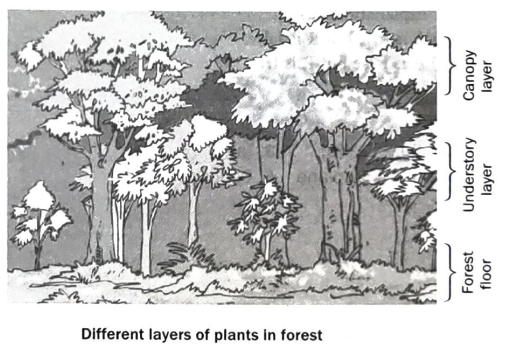
A well-developed forest has different types of trees, climbers, creepers, herbs and shrubs. These make different layers in the forest, which are described below.
1. Canopy
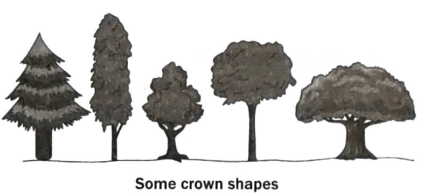
The uppermost branches and leaves of tall trees which act like a roof over the other plants in the forest is called canopy. It is the highest layer of vegetation in the forest. The branchy part of a tree above the stem is known as the crown of the tree.
Image

2. Understorey 
The different horizontal layers formed due to the different types of crowns in the forest are called understoreys. The constituents of understorey can be described as follows
(i) Top Layer It constitutes the giant and tall trees followed by shrubs and tall grasses.
(ii) Shrub Layer It has many shrubs and bushes of approximately 1-2 metres of height from the forest floor. It makes dense layer at some places of forest where enough sunlight is not present.
(iii) Herb Layer It occurs just below the shrub layer of plants. It is the lowest layer of vegetation in the forest having leafy plants. Most of the plants in herb layer have short lifespan. 
3. Forest Floor 
It is covered with different types of creepers. It has many kinds of insects, worms, toad stool, etc. Most of the forest floor is covered with dead and decaying leaves, fruits, seeds, twigs and small herbs.
Walking over the dead leaf layer on the forest floor feels like walking over a spongy carpet. It is generally dark as not much sunlight reaches here. Forest floor is warm and humid.
Thus, providing favourable conditions for seeds to germinate and develop into seedlings and saplings.
Image

Need a full question paper?

Generate a complete, print-ready paper with questions like this in minutes — across 16+ boards, with answer keys.

Start Generating Free

Similar questions

Prove with the help of an experiment that heat radiation can travel through vacuum.
With the help of an activity, explain how will you measure the time period of a simple pendulum.
In a class, the teacher was explaining a concept from weather and climate chapter. Anand got confused and slowly asked his teacher to repeat again. She smiled and started again. In equatorial belt the climate is hot and wet. It has evergreen rainforest and variety of plants. Similarly the vegetation of tropical region also has variations. The forest located between two tropics is called tropical forest. Desert shows arid region and only xerophytes are observed. These plants show specific modification for their survival in this arid region.
  1. Which type of forest is formed in equatorial region?
  2. What are the variation in vegetation seen in tropical forest?
  3. Give some adaptations of plants that are formed in desert.
  4. Some places conifers are seen. What are these places?
  5. What values do we observe in the teacher and Ar\and?
List the similarities and differences between aerobic and anaerobic respiration.
How does the structure of a leaf support its function in photosynthesis?
Name some fruit bearing plants. Now make a table and describe the method of seed dispersal in these fruits as well as the part which helps in the seed dispersal.
There are two animals $X$ and $Y.$ The animal $X$ has yellow brown colour while animal $Y$ has yellow brown colour with black stripes.
  1. Name the animals $X$ and $Y.$
  2. What is the other name for these animals?
  3. Where do these animals live?
  4. Wether these animals are carnivore or herbivore?
Observe and analyse the information given in the following flowchart. Complete the missing information.
Image
Describe the transport system in plants in detail.
Assume, a person is standing in front of a plane mirror. The distance between the mirror and his image is $6m$. If the person moves 2m towards the plane mirror, what would be the distance between the person and his image?