Bihar BoardEnglish MediumSTD 12 ScienceChemistrySurface Chemistry5 Marks
Question
Describe the dispersion methods for preparation of colloidal solution.
✓
Answer
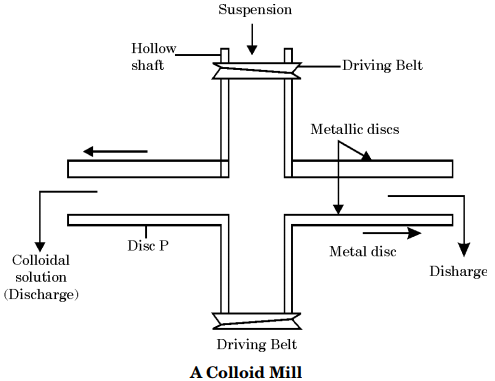
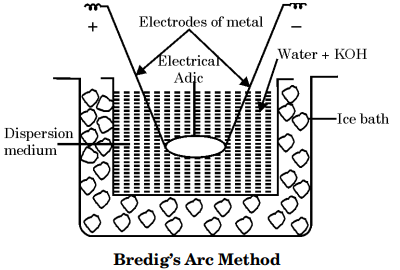
Preparation of Colloidal Solution Preparation of Lyophilic Colloids : Lyophilic colloids like strach, glue, gelatins may be prepared by simply warming the solid with the liquid dispersion medium, e.g., starch with water, solution of colloidal electrolytes such as soaps and dye stuffs can also be prepared similarly. 1. Dispersion Methods (i) Mechanical Dispersion : Solid material is first finely ground by usual methods. It is then mixed with a dispersion medium which gives a coarse suspension. The suspension is now introduced into the colloid mill. Two steel discs which have a very small clearance between them, are rotated in opposite directions at a very high speed. The solid along with the liquid dispersion medium (suspension), is fed between these plates. This assembly is known as Colloid mill (Fig.). The solid particles are ground down to colloidal size and are then dispersed in the liquid to give sol or colloidal solution. Colloidal graphite (a lubricant) and printing inks are made by this method. (ii) Electro-dispersion (Bredig's Arc Method) : This method is suitable for obtaining colloidal solutions of metals like gold, silver and platinum etc. An electric arc is set up between two metallic electrodes suspended in a trough of water. The intense heat of the arc converts the metal into vapours which are condensed immediately in the ice cold water resulting in the formation of colloidal solution. The intense heat of the spark across the electrodes, vaporises some of the metal and the vapour condenses under water. Thus, the atoms of the metal present in the vapour aggregate to form colloidal particles in water. The alkali $( NaOH$ or KOH $)$ act as stabilising agent. (iii) Ultrasonic dispersion : The sound waves of high frequency are usually called ultrasonic waves. The application of ultrasonic waves for the preparation of colloidal solution was first introduced by Wood and Loomis. Ultrasonic waves (sound waves of very high frequency of the order of 20000 cycle $/ sec$ ) are used for preparing the colloidal solution, e.g., colloidal solutions of Hg, metal sulphides and oxides etc. (iv) Peptization : The coversion of freshly formed precipitate into a sol or colloidal solution by the addition of a small amount of suitable electrolyte is called peptization. The electrolyte used is called peptizing agent. Example : For example, precipitate such as silver chloride, ferric hydroxide, aluminium hydroxide, can be converted into colloidal state by the addition of a small amount of a suitable electrolyte. Silver chloride $( AgCl )$ can be converted into a sol by adding hydrochloric acid. Ferric hydroxides $Fe ( OH )_3$, gives a sol (colloidal solution) by adding ferric chloride. $\underset{\text { Precipitate }}{ Fe ( OH )_3}+\underset{\text { Electrolyte }}{ Fe ^{3+}} \longrightarrow \underset{\text { Colloidal sol }}{ Fe ( OH )_3 Fe ^{3+}}$ Cadmium sulphide (CdS) or Arsenious sulphide can be peptized by adding hydrogen sulphide. Cause of Peptization : The cause of peptization is the adsorption of suitable ions. When electrolyte is added to freshly precipitated substances, the particles of the precipitate preferentially adsorb on common ions of the electrolyte. By electrostatic repulsion adsorbed ions split from the precipitate as colloidal particles.
Need a full question paper?
Generate a complete, print-ready paper with questions like this in minutes — across 16+ boards, with answer keys.