Question
Describe the evidence of evolution from comparative anatomy and morphology?

Answer

Morphological and comparative anatomical evidences:
  • The phylogenetic history can be revealed by comparative study of external and internal structures.
  • The organs with same structural design and origin but different functions are called homologous organs. For example, the forelimbs of some animals like whales, bats and cheetah have similar anatomical structure, i.e., humerus, radius, ulna, carpals, metacarpals and phalanges.
  • Due to different needs, some structures developed differently. This is called divergent evolution.
  • Other examples include vertebrate hearts or brains in animals; thorn and tendrils of Bougainvillea and cucurbita in plants.
  • The organs which are anatomically different but functionally similar are called analogous organs. For example, wings of butterfly and birds.
  • Due to same function, different structures evolve similarly. This is called convergent evolution.
  • Other examples include eye of octopus and mammals; flippers of penguins and dolphins; sweet potato (root modification) and potato (stem modification).

Need a full question paper?

Generate a complete, print-ready paper with questions like this in minutes — across 16+ boards, with answer keys.
Start Generating Free

Similar questions

Explain the ovarian and uterine events that occur during a menstrual cycle in a human female, under the influence of Pituitary and Ovarian hormones respectively.
List 10 modern day animals and using the various resources available link it to a corresponding ancient fossil. Name both of them.
A flower of brinjal plant following the process of sexual reproduction produces 360 viable seeds.
Answer the following questions giving reasons:
How many microspore mother cells must have undergone reduction division prior to dehiscence of another in the above case?
Describe the structure of DNA.###Describe the DNA proposed by Watson and Crick.
Differentiate between microsporogenesis and megasporogenesis. Which type of cell division occurs during these events? Name the structures formed at the end of these two events.
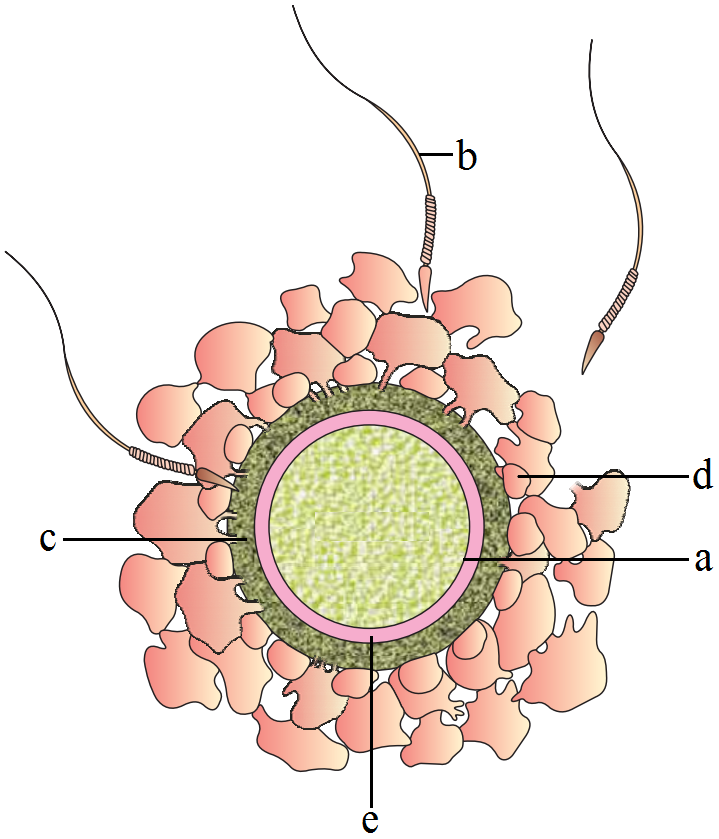
Study the illustration given and answer the questions that follow:

Name and state the function of ‘c’.

What is meant by microorganisms in industrial products? How do microorganisms help us in making beverages? Explain.
The biology teacher asked her students to verify the experiment on transformation principle in bacteria to establish DNA as genetic material. The class was divided into two groups. The teacher asked them to submit the reports. Group 2 did not use mouse and did not repeat Griffith's experiment. The teacher praised them.
  1. Which experiment did they perform?
  2. Explain the experiment in brief.
  3. Who and when performed the transformation principle experiment?
  4. What values did students of group 2 exhibit?
Describe in detail the human reproductive system.
(a) Briefly explain the events of fertilization and implantation in an adult human female.
(b) Comment on the role of placenta as an endocrine gland.