Question
Describe the froth floatation process of concentration of ores.

Answer

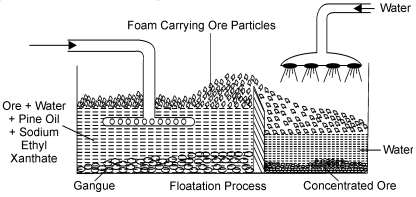
Froth Floatation Process :This method is used for the concentration of sulphide ores. In this method powdered ore is added to water containing pine oil and air is passed through it. Ore particles stick to the oil droplet and rise to the surface in the form of froth. Gangue particles are wetted by water and sink to the bottom.
Image

Need a full question paper?

Generate a complete, print-ready paper with questions like this in minutes — across 16+ boards, with answer keys.
Start Generating Free

Similar questions

Explain different types of Structural isomerism with example.
Read the following text carefully and answer the questions that follow:
A raw mango placed in concentrated salt solution loses water via osmosis and shrivel into pickle. Wilted flowers revive when placed in fresh water. A carrot that has become limp because of water loss into the atmosphere can be placed into the water making it firm once again. Water will move into its cells through osmosis. When placed in water containing less than 0.9% (mass/volume) salt, blood cells swell due to flow of water in them by osmosis.
i. People taking a lot of salt or salty food suffer from puffiness or edema. What is the reason behind this?
ii. The preservation of meat by salting and of fruits by adding sugar protects against bacterial action. How?
iii. Why the direction of osmosis gets reversed if a pressure larger than the osmotic pressure is applied to the solution side? Write its one application.
OR
iii.What care is generally taken during intravenous injections and why?
Explain Cross aldol condensation with suitable example. ### Write a short note: Cross aldol condensation.
Read the following text carefully and answer the questions that follow:
The solutions which boil at a constant temperature like a pure liquid and possess the same composition in liquid, as well as vapour state are called azeotropes. The components of azeotropes cannot be separated by fractional distillation. Only non-ideal solutions form azeotropes. Solutions with negative deviation form maximum boiling azeotrope and the solutions with positive deviation form minimum boiling azeotrope. The boiling point of azeotrope is never equal to the boiling points of any of the components of the azeotrope.
i. The azeotropic solutions of two miscible liquids show what type of deviation from Raoult's law? 
ii. The azeotropic mixture of water & HCI boils at 108.5°C. What type of deviation is shown by the solution?
Does this solution behave as ideal or non-ideal? 
iii. Do ideal solutions form azeotropes?
Write detailed note on the addition reaction of aldehydes and ketones with ammonia derivatives.
Write the mechanism of hydration of ethene to yield ethanol.
(i) Draw the structures of all isomeric alcohols of molecular formula $C _5 H _{12} O$ and give their IUPAC names.
(ii) Classify the isomers of alcohols in question 7.3. (i) as primary, secondary and tertiary alcohols.
What is ligand? Explain classification of ligand.
The rate constant for the first order decomposition of $H_{2}O_{2}$ is given by the following equation: $log~k=14.2-\frac{1.0\times10^{4}K}{T}$. Calculate $E_a$ for this reaction and rate constant k if its half-life period be 200 minute.
( given $R =8.314 J K ^{-1} mol^{-1}$)
Explain giving reasons :
(i) Alcohols are generally soluble in water.
(ii) Phenols boil at higher temperature than arenes of comparable molecular mass.
(iii) The lower homologues of alcohols are soluble in water whereas phenols are slightly soluble in water.
(v) Boiling point of an alcohol is higher than the corresponding alkane.
(vi) The solubility of alcohols in water decreases with increase in molecular mass.