Question
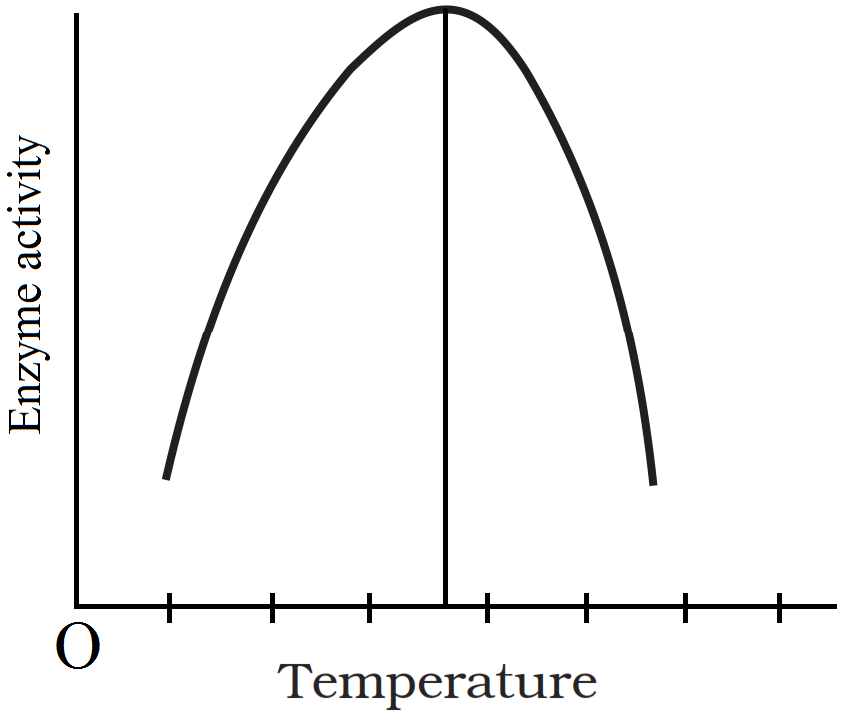
Describe the influence of temperature on enzyme action.

Answer

Enzymes generally function at a narrow range of temperature. The temperature at which the enzyme shows its maximum activity, is called its optimum temperature. The enzyme activity decreases at temperatures below and above the optimum temperature. At low temperatures, the enzyme is inactive, while at high temperature, the enzyme is denatured and so it loses its activity.

Need a full question paper?

Generate a complete, print-ready paper with questions like this in minutes — across 16+ boards, with answer keys.
Start Generating Free

Similar questions

The male and female reproductive organs of several pteridophytes and gymnosperms are comparable to floral structures of angiosperms. Make an attempt to compare the various reproductive parts of pteridophytes and gymnosperms with reproductive structures of angiosperms.
During a college tour, while travelling at a higher altitude of maintains, Vijay complains of dizziness and vomiting sensation. The guide took him to the doctor. The doctor after diagnosing him gave some medicines and explained that it happened due to the change in air pressure, as we go towards the higher altitude.
  1. What is the cause of Vijay's sickness?
  2. Which of the sensory organ get disturbed during the journey?
  3. Name the part of the ear that maintains the air pressure.
  4. What values did the guide possess?
Differentiate between
i. Myogenic heart and neurogenic heart.
ii. Lymphatic capillaries and blood capillaries.
Ankit, a Xl class student was continuously listening to his sister and her friend's discussion about the growth of plant. They were discussing that plant growth involves three phenomena, i.e., differentiation, dedifferentiation and redifferention. Listening this Ankit interrupted them in between and asked her sister to elaborate the things in detail and the basic phenomenon behind it. As the topic was the part of the Ankit's syllabus also. Her sister explained him that the cells in plant undergo differentiation to attain a maturity in order to perform specific functions.
  1. What is dedifferentiation? Name two tissues formed by this process phenomenon.
  2. What is redifferentiation?
  3. What value is learnt from the Ankit's character as an ideal biology student.
What is meant by coronary artery disease?
Neha planned to go the lakeside for picnic with her friends. Suddenly they noticed a man drowning in the lake. Everyone was frightened, but Neha asked them to stop panicking and take the man out of water. After the man was rescued, he was found unconscious. Neha then suggested that mouth to mouth artificial respiration should be given to save the man. One of her friend did as she guided.Finally, the man was saved. He thanked Neha and her friends for their help.
  1. Why is artificial respiration given?
  2. Can artificial respiration bring back a person to consciousness even after death?
  3. What values are shown by Neha?
Write any four differences between enzymes and co-enzymes.
Name the internal/plant factors that determine the rate of photosynthesis.
Discuss the types of enzyme cofactors that are required for the efficient activity of enzymes.
You have heard about several insectivorous plants that feed on insects. Nepenthes or the pitcher plant is one such example, which usually grows in shallow water or in marsh lands. What part of the plant is modified into a ‘pitcher’? How does this modification help the plant for food even though it can photosynthesize like any other green plant?