Question
Describe the interior of the earth.
Answer

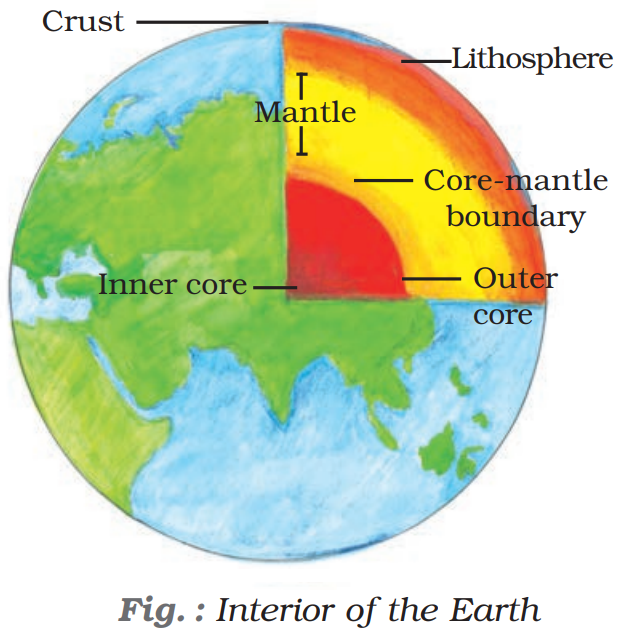
Interior of the Earth:The earth is made up of several concentric layers with one inside another, just like an onion.
Crust:
  • The uppermost layer on the earth's surface is called the crust.
  • It is the thinnest of all the layers.
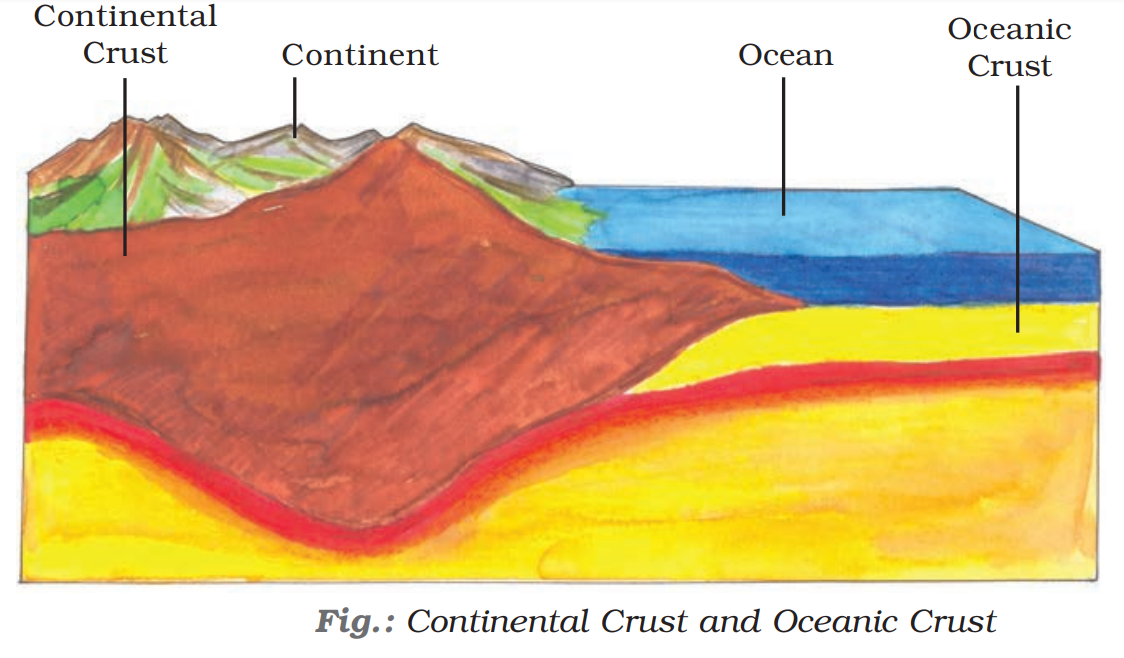
  • It is about 35km, thick on the continental masses and only 5km thick on the ocean floors.
  • Main minerals constituent of the continental mass are silica and alumina.
  • It is thus called sial (si– silica and al– alumina).
  • The oceanic crust mainly consists of silica and magnesium.
  • It is therefore called sima (si– silica and ma– magnesium).
​​​​​​​
Mantle:
  • Just beneath the crust is the mantle.
  • It extends up to a depth of 2900km below the crust.
Core:
  • The innermost layer is the core with a radius of about 3500km.
  • It is mainly made up of nickel and iron.
  • Hence it is called nife (ni- nickel and fe- ferrous i.e., iron).
  • The central core has very high temperature and pressure.

Need a full question paper?

Generate a complete, print-ready paper with questions like this in minutes — across 16+ boards, with answer keys.

Start Generating Free

Similar questions

Match the following:
(a)
The Buddha
(i)
Namghar
(b)
Shankaradeva
(ii)
Worship of Vishnu
(c)
Nizamuddin Auliya
(iii)
Questioned social differnces
(d)
Nayanars
(iv)
Sufi saint
(c)
Alvars
(v)
Worship of Shiva
Examine the style of architecture from the 12th century.
Explain the main features of Public Health Services.
Jyotsna is deciding what clothes to pack for her school trip to Mumbai in June. She looks at the weather forecast, which predicts 29°C and 84% humidity. What would be your advice to her?
Describe how forts were constructed during Shah Jahan’s reign.
How did Burhan-ul-Mulk become powerful?
What were the key cultural, historical and societal features of the Ahom tribes?
Read the following statement by a well-known environmental thinker, David Suzuki:
“The way we see the world shapes the way we treat it. If a mountain is a deity, not a pile of ore; if a river is one of the veins of the land, not potential irrigation water; if a forest is a sacred grove, not timber; if other species are biological kin, not resources; or if the planet is our mother, not an opportunity-then we will treat each other with greater respect. Thus is the challenge, to look at the world from a different perspective.” Discuss in small groups. What do you think this statement means? What implication does it have for our actions with respect to the air, water, land, trees and mountains around us?
List the sacred sites in your region. Enquire, into why they are considered sacred. Are there stories connected with these sacred places? Write a short essay of 150 words.
Who was Mahmud Ghazni? How did he expand his kingdom?