Question
Describe the logistic population growth.

Answer

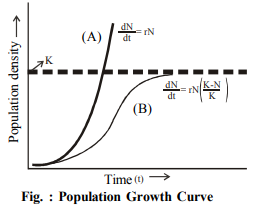
Logistic Growth : No population of any species in nature has at its disposal unlimited resources to permit exponential growth. This leads to competition between individuals for limiting resources. Eventually, the 'fittest' individual will survive and reproduce. A population growing in a habitat with limited resources show initially a lag phase, followed by phases of acceleration and deceleration and finally an asymptote, when the population density reaches the carrying capacity. A plot of N in relation to time (t) results in a sigmoid curve. This type of population growth is called Verhulst-Pearl Logistic Growth and is described by the following equation;
$dN / dt =\frac{ rN ( K - N )}{ K }$
Where, N = Population density at time t
r = Intrinsic rate of natural increase
K = Carrying capacity
Since resources for growth for most animal populations are finite and become limiting sooner or later, the logistic growth model is considered a more realistic one.
Image
(A) When responses are not limiting the growth, plot is exponential. 
(B) When responses are limiting the growth, plot is logistic, K is carrying capacity.

Need a full question paper?

Generate a complete, print-ready paper with questions like this in minutes — across 16+ boards, with answer keys.
Start Generating Free

Similar questions

A child suffering from thalassemia is born to a normal couple. But the mother is being blamed by the family for delivering a sick baby.
  1. What is thalassemia?
  2. How would you counsel the family not to blame the mother for delivering a child suffering from this disease? Explain.
  3. List the values your counselling can propagate in the families.
‘There is a paternity dispute for a child’. Which technique can solve the problem. Discuss the principle involved.
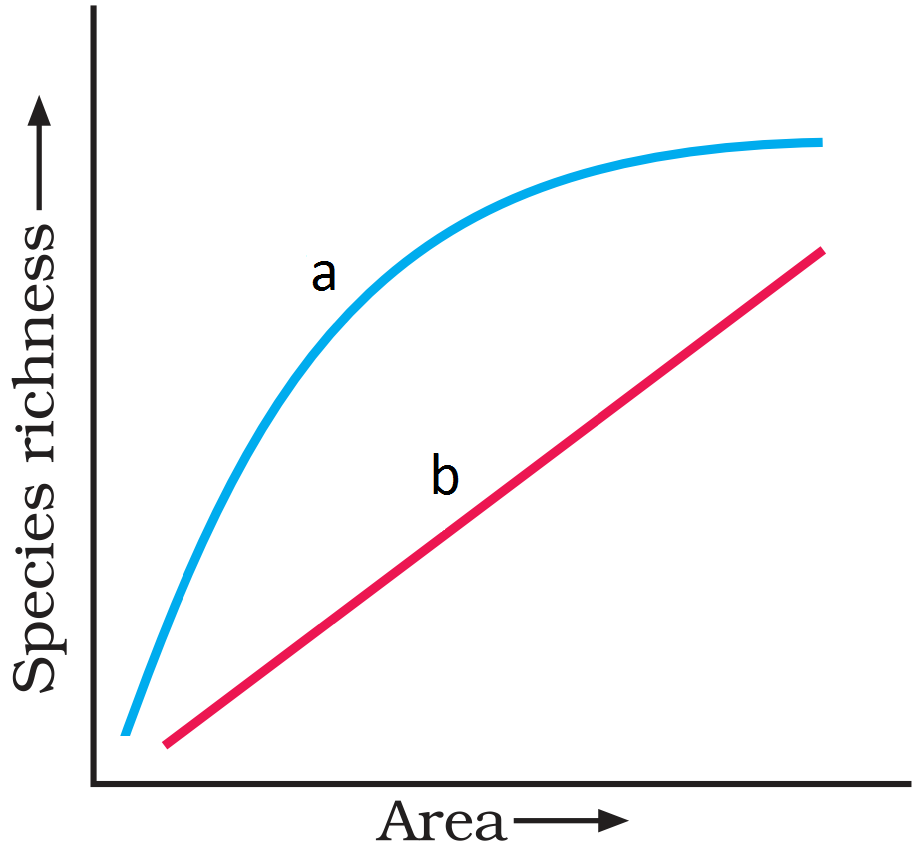
The graph shows species-area relationship:

  1. If b denotes the relationship on log scale-
  1. Describe a and b.
  2. How is slope represented? Give the normal range of slope.
  3. What kind of slope will be observed for frugivorous birds and mammals in a tropical forest?
  1. Species diversity of plants (22%) is much less than that of animals (72%). Analyze the reasons for greater diversity of animals as compared to plants.


Describe the events of spermatogenesis with the help of a schematic representation.
  1. Work out a dihybrid cross upto F, generation between pea plants bearing violet-coloured axial flowers and white-coloured terminal flowers. Give their phenotypic ratio.
  2. State the Mendel's law of inheritance that was derived from such a cross.
Two organisms occupying a particular geographical area (say desert) show similar adaptive strategies. Taking examples, describe the phenomenon.
Give the term/ reason:
Sperm cannot reach ovum without seminal plasma.
A pregnant human female was advised to undergo M.T.P. It was diagnosed by her doctor that the foetus she is carrying has developed from a zygote formed by an XX egg fertilised by Y–carrying sperms. Why was she advised to undergo M.T.P.?
Jeremy went to a butcher's shop with his father and saw that the goats before slaughter were fed on grasses and was fascinated to see the sequence of organism through which the food passes. On seeing his fascination his father asked him the reason and he quickly explained him the concept of food chain.
  1. Describe food chain.
  2. Grass was eaten by goat which in turn is consumed by humans. Explain their relation.
  3. Name different types of food chains.
  4. What values are shown by Jeremy?
Draw a diagram and describe the immune system found in humans.