Question
Describe the pathway followed by phosphorus in an ecosystem.
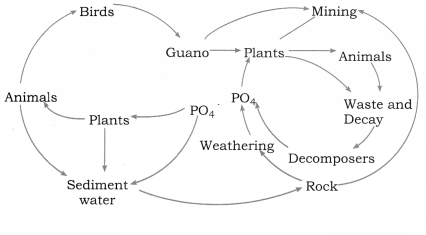
(1) The phosphorus cycle is the simplest of all the nutrient cycles, which is a type of sedimentary cycle. It constitutes cyclic movement of phosphorus through hydrosphere, lithosphere and biosphere.
(2) Since phosphorus is a heavy molecule it never goes into the atmosphere. Phosphorus remains in the bodies of organisms, dissolved in water or in the form of rock. The natural reservoir of phosphorus is rock in which phosphorus is present in the form of phophates.
(3) Upon weathering of the rock due to action of mildly acidic water, the phosphates in the rock go into the solution.
(4) Plants take up phosphorus in the form of phosphate. The roots of plants can absorb phosphate ions from the soil. Animals obtain phosphorus through food which they consume. Thus autotrophs supply phosphorus to heterotrophs. Phosphorus is a major biological constituent of all the living organisms.
It is found in biological membranes, nucleic acids e.g. DNA, RNA, cellular energy transfer systems such as ATE Phosphorus is thus an essential element.
(5) The requirement of phosphorus in animals is much more as it is the component of bones, hooves, teeth, shells.
(6) The waste products formed through defecation and the dead organisms are decomposed by phosphate-solubilizing bacteria releasing phosphorus. This in turn is used up by other growing plants. Phosphorus is always in short supply and hence acts as limiting factor for the plant growth.
Sudden influx of phosphorus in the form of agricultural runoff or industrial effluents rich in phosphate content, leads to eutrophication in water bodies. Eutrophication is due to overgrowth of algae at the instance of high phosphorus dissolved in water. The overgrowth of algae kills or harms the aquatic life.
Generate a complete, print-ready paper with questions like this in minutes — across 16+ boards, with answer keys.