Question
Describe the process of fertilisation in human beings.
Answer

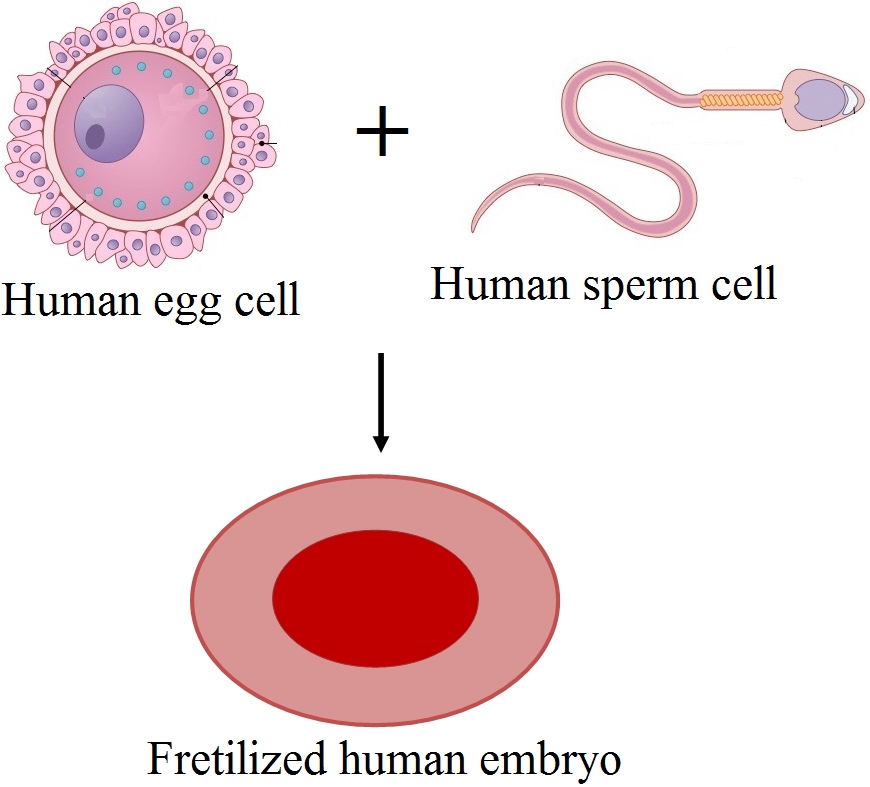
Fertilization involves the fusion of the male and the female gamete. The male and the female gametes are released from the male and the female reproductive organs. Sperms or male gametes are released from the male reproductive organ i.e., the penis. These sperms then enter the female body through the vagina. Then, they travel through the fallopian tubes where they meet the eggs. Hence, the process of fertilization takes place in the fallopian tubes.

During fertilization, the haploid nucleus of the sperm and that of the ovum fuse with each other to form the zygote. This zygote divides to form an embryo which in turn develops into a foetus.

Need a full question paper?

Generate a complete, print-ready paper with questions like this in minutes — across 16+ boards, with answer keys.

Start Generating Free

Similar questions

Match the items of Column A with those of Column B.
  Column A   Column B
(a) Sulphur dioxide (i) Damage ozone layer.
(b) Carbon dioxide (ii) Reduces oxygencarrying capacity of blood.
(c) Carbon monoxide (iii) Acid rain.
(d) Chlorofluorocarbons (iv) Green house gas.
Define frictional force (or friction).
The part of $P$ and $Q$ are present only in plant cells, and they are not present in animal cells. The part $P$ contains a green pigment called $R$ whereas part $Q$ is made of a tough material $S$. The part $P$ takes part in the food making process whereas part $Q$ gives shape and support to the plant cell.
$a.$ What is $(i) P$, and $(ii) Q?$
$b.$ What is $(i) R$, and $(ii) S?$
Classify the following elements into metals, non-metals and metalloids: Copper, Sulphur, Aluminium, Oxygen, Silicon, Nitrogen, Germanium, Mercury, Chlorine, Sodium.
With the help of a labelled diagram, describe briefly how an iron key can be electroplated with copper.
Give an example to show that friction depends on the force with which the two surfaces are pressed together.
What kind of friction comes into play:
$a.$ When a block of wood kept on table moves slowly?
$b.$ When a block of wood kept on table just tends to move (or slip)?
$c.$ When a block of wood kept on cylindrical iron rods moves?
The animal $A$ which is classified as an amphibian lays eggs in pond water. The hatching of its eggs produces a tailed$-$form $B$ which looks very different from the animal $A$. The form $B$ then undergoes a change $C$ and gets converted into animal $A$.
$1.$ Name $(i)$ animal $A$ and $(ii)$ form $B$.
$2.$ What is the change $C$ known as?
$3.$ Name the breathing organs of $A$.
$4.$ What are the breathing organs of $B$?
Give examples to show that friction depends on the nature of two surfaces in contact.
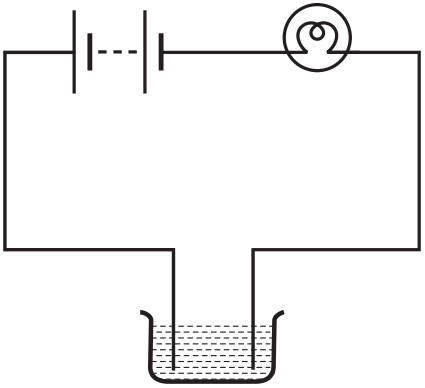
The bulb does not glow in the setup shown in Fig. $14.10$. List the possible reasons. Explain your answer.