Asexual and Sexual Reproduction in Plants — BIO BOTANY STD 12 — Question
Tamilnadu BoardEnglish MediumSTD 12BIO BOTANYAsexual and Sexual Reproduction in Plants5 Marks
Question
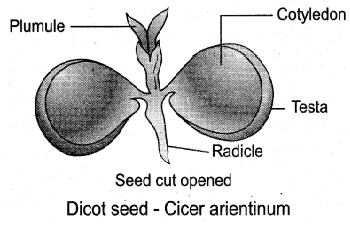
Describe the structure of a dicot seed.
✓
Answer
Structure of a Cicer seed as an example for Dicot seed The mature seeds are attached to the fruit wall by a stalk called funiculus. The funiculus disappears leaving a scar called hilum. Below the hilum a small pore called micropyle is present. It facilitates entry of oxygen and water into the seeds during germination. Each seed has a thick outer covering called seed coat. The seed coat is developed from integuments of the ovule. The outer coat is called testa and is hard whereas the inner coat is thin, membranous and is called tegmen.
In Pea plant the tegmen and testa are fused. Two cotyledons laterally attached to the embryonic axis are present. It stores the food materials in pea whereas in other seeds like castor the endosperm contains reserve food and the cotyledons are thin. The portion of embryonal axis projecting beyond the cotyledons is called radicle or embryonic root. The other end of the axis called embryonic shoot is the plumule.
Embryonal axis above the level of cotyledon is called epicotyl whereas the cylindrical region between the level of cotyledon is called hypocotyl. The epicotyl terminates in plumule whereas the hypocotyl ends in radicle.
Need a full question paper?
Generate a complete, print-ready paper with questions like this in minutes — across 16+ boards, with answer keys.