Reproduction in Lower and Higher Animals — BIOLOGY STD 12 Science — Question
Maharashtra BoardEnglish MediumSTD 12 ScienceBIOLOGYReproduction in Lower and Higher Animals5 Marks
Question
Describe the structure of blastocyst or blastulation
✓
Answer
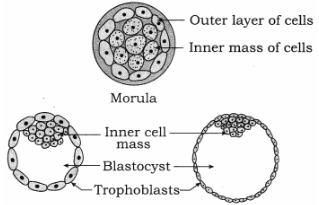
The outer layer of cells of the morula is called trophoblast or trophoectoderm. This layer absorbs the nutritive fluid secreted by uterine endometrial membrane.
As more and more fluid is absorbed by trophoblast cells, the cells become flat and a cavity called blastocyst cavity or blastocoel or segmentation cavity is formed.
This causes trophoblast cells to get separated from inner cell mass except at one side.
The trophoblast cells in contact with embryonal knob are known as cells of Rauber. As the quantity of fluid increases, the morula enlarges rapidly and assumes the shape of a cyst. This stage is called blastocyst.
The side of the blastocyst to which embryonal knob is attached is known as the embryonic or animal pole and the opposite side as abembryonic pole.
The trophoblast produces extra embryonic membranes and does not participate in the formation of embryo proper.
Zona pellucida disappears allowing the blastula to increase in size and volume. The blastocyst stage is reached in about five days after fertilization.
Blastocyst depends on mother for nutrition which it obtained through placenta.
Need a full question paper?
Generate a complete, print-ready paper with questions like this in minutes — across 16+ boards, with answer keys.