Question
Describe the structure of Brain.

Answer

Structure of brain. The human brain is well protected by the skull. Inside the skull, the brain is covered by cranial meanings consisting of an outer layer called dura mater, a very thin middle layer called archnoid and an inner layer (which is in contact with the brain tissue) called pia mater. The brain can be divided into three major parts.
(i) Forebrain (ii) Midbrain and (iii) Hindbrain

Need a full question paper?

Generate a complete, print-ready paper with questions like this in minutes — across 16+ boards, with answer keys.
Start Generating Free

Similar questions

Which vascular system is found in humans? Write any three importance of this system.
What are histones? What are their functions?
Explain how during light reaction of photosynthesis, ATP synthesis as a chemiosmotic phenomenon takes place?
Define the following:
  1. Respiration.
  2. Respiratory substrate.
  3. How does a tree trunk exchange gases with the environment although it lacks stomata?
  4. Which is the most important energy carrier? Is this compound mobile?
  5. Name the major respiratory substrates used by most organisms. It unavailable at time, what other substances can be used for respiration?
A rubber band stretches and reverts back to its original position. Bubble gum stretches, but it would not return to its original position.
Is there any difference between the two processes? Discuss it with respect to plant growth (Hint: Elasticity (reversible) Plasticity (irreversible)).
Explain with examples the categories determined on the basis of nitrogenous excreting substances.
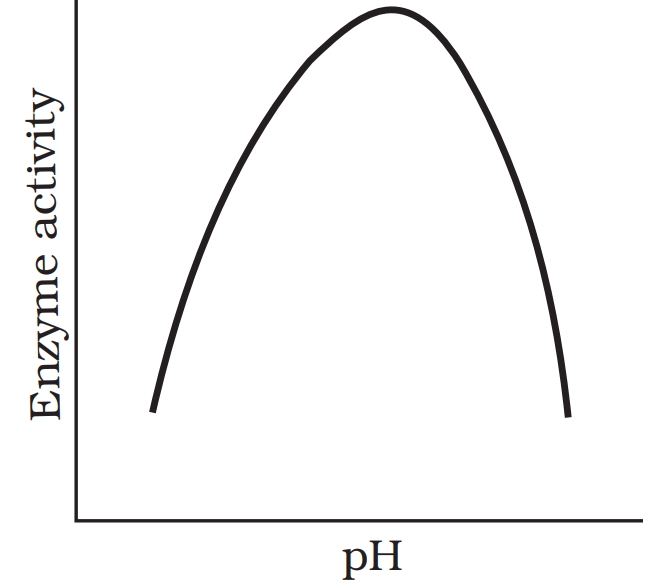
Enzymes are proteins. Proteins are long chains of aminoacids linked to each other by peptide bonds. Aminoacids have many functional groups in their structure. These functional groups are, many of them at least, ionisable. As they are weak acids and bases in chemical nature, this ionization is influenced by pH of the solution. For many enzymes, activity is influenced by surrounding pH. This is depicted in the curve below, explain briefly.

The glomerular filtrate in the loop of Henle gets concentrated in the descending limb and then gets diluted in the ascending limb. Explain.
State the condition in which the flowers are described.
  1. Perigynous.
  2. Epigynous and.
  3. Hypogynous.
Give one example of each plant in whih these flowers are found.
Name the division in which true jaws are absent. Write any four differences between Pisces and Tetrapoda super class.