Question
Describe the structure of diborane.

Answer

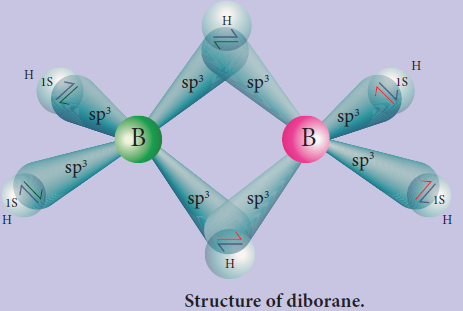
In diborane, two $BH _2$ units are linked by two bridged hydrogens. Therefore, it has eight $B - H$ bonds. However, diborane has only 12 valance electrons and are not sufficient to form normal covalent bonds. The four-terminal B-H bonds are normal covalent bonds (two centre - twoelectron bond or $2 c -2 e$ bond). The remaining four electrons have to used for the bridged bonds, i.e. two-three centred B-H-B bonds utilise two electrons each.
Hence, these bonds are three centre - two-electron bonds. The bridging hydrogen atoms are in a plane as shown in the figure. In dibome, the boron is $sp ^3$ hybridised. Three of the four $sp ^3$ hybridised orbitals contains a single electron and the fourth orbital is empty.
Two of the half-filled hybridised orbitals of each boron overlap with the two hydrogens to form four-terminal 2 c -2e bonds, leaving one empty and one half filled hybridised orbitals on each boron. The Three centre - two-electron bonds, B-H-B bond formation involves overlapping the half-filled hybridised orbital of one boron, the empty hybridised orbital of the other boron and the half-filled 1s orbital of hydrogen.
Image
Structure of diborane

Need a full question paper?

Generate a complete, print-ready paper with questions like this in minutes — across 16+ boards, with answer keys.
Start Generating Free

Similar questions

 An organic compound (A) of molecular formula $C _3 H _6$ on hydration in the presence of $H _2 SO _4$ gives (B) $C _3 H _5 O$ which gives blue colour In victor meyer's test. (B) on treatment with Cu at 573 K gives $C _3 H _6 O$ a compound (C) on self condensation in the presence of magnesium amalgam and water gives (D) of formula $C _6 H _{14} O _2$. Identify $A , B , C , D$ and explain the reaction involved.
Compound A is used in the manufacture of opticals. A on heating gives B. B further heating to form C. A reacts with hydrochloric acid to give D. Identify A, B and C. Explain the reaction.
  1. How is bleaching powder prepared?
  2. What happens when benzene reacts with chlorine?
Explain free radical polymerisation with example.
An organic compound (A) of molecular formula $C _2 H _6 O$ on reaction with acidified $K _2 Cr _2 O _7$ gives (B) of molecular formula $C _2 H _4 O$ which on further oxidation gives (C) of molecular formula $C _2 H _4 O _2$. Compound $\left( C\right.$ ) reacts with (A) in the presence of conc. $H _2 SO _4$ gives (D) of molecular formula $C _4 H _8 O _2$. Identify $A, B, C, D$ and explain the reaction Involved.
Write the formulae for the following coordination compounds :
Answer:
  1. Tetraamminediaquacobalt (III) chloride.
  2. Potassium tetracyanonickelate (II).
  3. Tris ( ethane – 1, 2 – diamine ) chromium (III) chloride.
  4. Amminebromidochloridonitrito – N – platinate (II).
  5. Dichlorobis(ethane – 1, 2 – diamine ) platinum (IV) nitrate.
  6. Iron (III) hexacyanoferrate (II)
Explain about the various dehydration reactions of ethylene glycol.
Explain the mechanism of Cannizaro reaction.
Derive an expression for Ostwald’s dilution law.
An organic compound (A) of molecular formula $C _2 H _5 NO$ on treatment with $LiAlH _4$ gives (B) of formula $C _2 H _7 N$. ( A ) on treatment with $Br _2$ and excess of caustic alkali gives ( $C$ ) of formula $CH _5 N$. ( $A$ ) on treatment with phosphorous pentoxide gives ( $D$ ) of molecular formula $C _2 H _3 N$ Identify $A, B, C, D$ and explain the reaclions involved.