Question
Describe the term ‘inertia’ with respect to motion.

Answer

Inertia of motion is the property of a body due to which it resists a change in its state of uniform motion. For eg., if there is no air resistance and no friction to oppose the motion of a moving bicycle, it will go on moving forever.

Need a full question paper?

Generate a complete, print-ready paper with questions like this in minutes — across 16+ boards, with answer keys.

Start Generating Free

Similar questions

Which characteristic of the sound helps you to identify your friend by his voice while sitting with others in a dark room?
Name the different types of elements found in the xylem.
Calculate the force of gravitation between two objects of masses $50kg$ and $120kg$ respectively kept at a distance of $10m$ from one another. (Gravitational constant, $G = 6.7 \times 10^{-11}Nm^2 kg^{-2}$)
Which of the above two graphs (a) and (b) (Fig.) representing the human voice is likely to be the male voice? Give reason for your answer.
What is ozone tayer $(=$ umbrela$)?$
The atomic species $A$ and $B$ have different number of protons but the same number of nucleons. On the other hand, the atomic species $X$ and $Y$ have the same number of protons but different number of nucleons. Which pair is an example of isobars? Why?
The values of g at six distances $A , B , C , D , E$ and F from the surface of the earth are found to be $3.08 m / s ^2, 9.2 .3 m / s ^2$, $0.57 m / s ^2, 7.34 m / s ^2, 0.30 m / s ^2$ and $1.49 m / s ^2$, respectively.
a. Arrange these values of $g$ according to the increasing distances from the surface of the earth (keeping the value of $g$ nearest to the surface of the earth first).
b. If the value of distance $F$ be $10000\ km$ from the surface of the earth, state whether this distance is deep inside the earth or high up in the sky. Give reason for your answer.
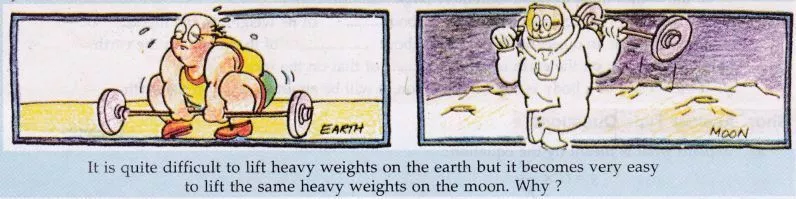
How much is the weight of an object on the moon as compared to its weight on the earth? Give reason for your answer.

State an important characteristic of uniform circular motion. Name the force which brings about uniform circular motion.
Compare an electron and a proton in respect of mass and charge.