Question
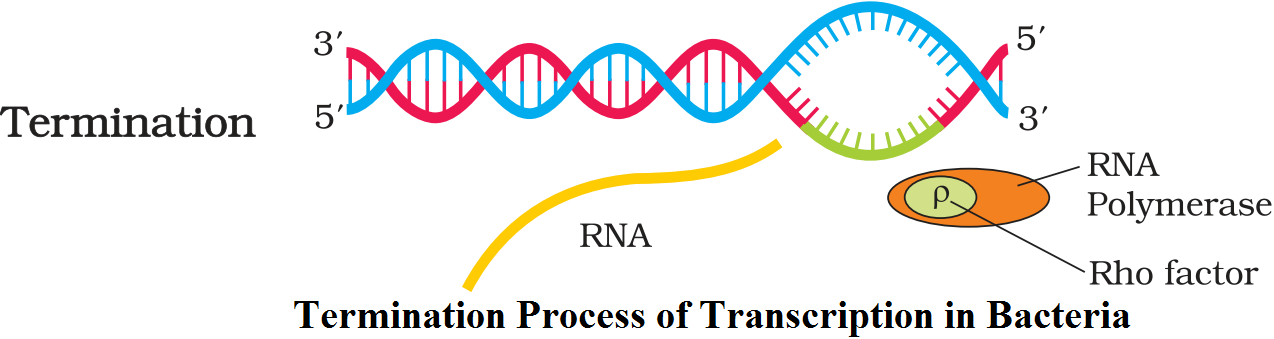
Describe the termination process of transcription in bacterium.

Answer

  1. Once the RNA polymerase reaches the terminator sequence of the DNA, it binds transiently to the termination factor (rho/ p).
  2. The RNA strand synthesised falls off, followed by the RNA polymerase, i.e., termination has occurred.
​​​​​​​

Need a full question paper?

Generate a complete, print-ready paper with questions like this in minutes — across 16+ boards, with answer keys.
Start Generating Free

Similar questions

Give scientific reasons:
(a) The pyramid of energy is always upright.
(b) In an ecosystem the energy flow is always unidirectional.
Explain in detail the regions associated with the diencephalon.
Only asexual reproduction can give rise to individuals resembling their parent. Do you agree with the statement? Support your answer with an example.
How did Louis Pasteur successfully demolish the popular theory of spontaneous generation?
The cytological observations made in a number of insects led to the development of the concept of genetic/ chromosomal basis of sex-determination mechanism. Honey bee is an interesting example to study the mechanism of sex-determination. Study the schematic cross between the male and the female honey bees given below and answer the questions that follow:
  1. Identify the cell divisions ‘A’ and ‘B’ that lead to gamete formation in female and male honey bees respectively.
  2. Name the process ‘C’ that leads to the development of male honey bee (drone).
Sketch and label anatomical structure of human eye.
  1. A DNA segment has a total of 1,500 nucleotides, out of which 410 are Guanine containing nucleotides. How many pyrimidine bases this segment possesses?
  2. Draw a diagrammatic sketch of a portion of DNA segment to support your answer.
Trace the development of female gametophyte (embryo sac) from megaspore mother cell in a flower. Give a labelled diagram of the final stage of female gametophyte.
Study the population growth curves in the graph given below and answer the questions which follow:
  1. Identify the growth curves ‘a’ and ‘b'.
  2. Which one of them is considered a more realistic one and why?
  3. If dN/dt=rN(K-N/K) is the equation of the logistic growth curve, what does K stand for?
  4. What is symbolised by N?
Name the different types of pollution.