Reproductive Health — BIOLOGY STD 12 Science — Question
Bihar BoardEnglish MediumSTD 12 ScienceBIOLOGYReproductive Health3 Marks
Question
Describe the various methods of birth control.
✓
Answer
Birth Control: The most important step to control population growth is to motivate smaller families by using various contraceptive methods. An ideal contraceptive should be:
User–friendly.
Easily available.
Effective and reversible with no or least side–effects.
Non–interfering with the sexual drive/ desire and/ or the sexual act of the user.
Methods of Birth Control: The contraceptive methods are divided into following categories:
Natural/ Traditional methods.
Barrier methods.
Intra uterine devices (IUDs).
Oral contraceptives.
Injections and implants.
Surgical methods.
Natural methods:
These are natural methods that work on the principle of avoiding the meeting of ovum and sperm.
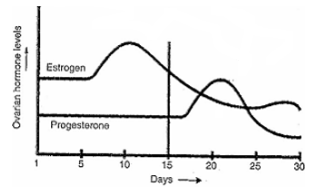
Periodic abstinence is a method in which a couple avoids or abstains from coitus from day 10-17 of the menstrual cycle, when ovulation is expected to occur.
Coitus interruptus or withdrawal is a method in which male partner withdraws his penis from the vagina just before ejaculation so as to avoid insemination.
Lactational amenorrhea is based on the principle that during the period of lactation after parturition, ovulation does not occur.
Barrier methods:
These methods prevent the contact of sperm and ovum with the help of barriers. Such methods are available for both males and females.
Condoms are barriers made of thin rubber/ latex sheath used to cover the penis in the male or vagina and cervix in females. It prevents the deposition of ejaculated semen into the vagina of the female.
Diaphragms, cervical caps and vaults are the barriers made of rubber that are inserted into the female reproductive tract to cover the cervix during coitus. They prevent the entry of sperms through cervix.
Spermicidal creams, jellies and foams are used along with these barriers to increase their contraceptive efficiency.
Intra uterine devices (IUDs):
These devices are inserted by doctors in the uterus through vagina.
There are three types of IUDs available:
Non-medicated IUDs: These increase phagocytosis of sperms within the uterus, e.g., Lippes loop.
Copper releasing IUDs: Along with phagocytosis of sperms, the copper ions released suppress sperm motility and fertilising capacity of sperms, e.g., CuT, Cu 7, Multiload 375.
Hormone releasing IUDs: These make the uterus unsuitable for implantation and the cervix hostile to sperms, e.g., Progestasert, LNG-20.
Oral contraceptive:
This involves uptake of hormonal preparations of either progestogens or progestogen–estrogen combinations in the form of pills by females.
They inhibit ovulation and implantation as well as alter the quality of cervical mucus to prevent entry of sperms.
‘Saheli’, an oral contraceptive for females containing a non-steroidal preparation was developed by scientists at Central Drug Research Institute (CDRI) in Lucknow.
Pills have high contraceptive value and few side effects.
Injections and implants:
Progestogens or progestogen–estrogen combination can also be used by females as injections or implants under the skin.
Their mode of action is similar to that of pills but their effective periods are longer.
Surgical methods (Sterilisation):
These are terminal and permanent methods which block the transport of gametes, thereby preventing conception.
In males, a small part of the vas deferens is removed and tied up through a small incision onthe scrotum. This is called vasectomy.
In females, a small part of the fallopian tube is removed and tied up through a small incision in the abdomen or vagina. This is called tubectomy.
Need a full question paper?
Generate a complete, print-ready paper with questions like this in minutes — across 16+ boards, with answer keys.