Question
Describe the various types of age pyramids.

Answer

Age pyramids are of three types:
  1. Triangular age pyramids: The number of pre-reproductive individuals is very large. Number of reproductive individuals is moderate while post-reproductive individuals are fewer. Population is growing.
  2. Bell shaped age pyramids: The number of pre-reproductive and reproductive individuals is almost equal. post-reproductive individuals are comparatively fewer. The population size remains stable.
  3. Urn shaped age pyramid: Proportion of reproductive age group is higher than the individuals in pre-reproductive age group. Number of post-reproductive individuals is also sizeable. It is declining population with negative growth.

Need a full question paper?

Generate a complete, print-ready paper with questions like this in minutes — across 16+ boards, with answer keys.
Start Generating Free

Similar questions

Fill in the missing stages in the given primary hydrarch succession.
Phytoplankton → (a) → (b) → (c) → Submerged free-floating → (d) → Forest plant stage.
What is common between hydrarch and xerarch succession?
Explain aquatic ecosystem by taking example of small pond.
What is sere? Which species can be named as dominant species?
In pea plants, the colour of the flower is either violet or white, whereas human skin colour shows many gradations. Explain giving reasons, how it is possible.
How do homologous organs represent divergent evolution? Explain with the help of a suitable example.
What are transgenic plants? Give some example.
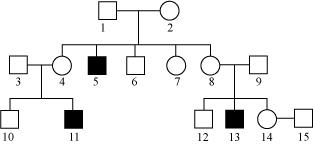
Haemophilia is a sex-linked recessive disorder of humans. The pedigree chart given below shows the inheritance of haemophilia in one family. Study the pattern of inheritance and answer the questions given.

  1. Give all the possible genotypes of the members 4; 5 and 6 in the pedigree chart.
  2. A blood test shows that the individual 14 is a carrier of haemophilia. The member numbered 15 has recently married the member numbered 14. What is the probability that their first child will be a haemophilia male?
Differentiate between : (i) Epicotyl and hypocotyl, (ii) Coleoptile and coleorrhiza, (iii) Integument and testa, (iv) Perisperm and pericarp
How many ova will be produced by one fully grown primary oocyte?
  1. How has the development of bioreactor helped in biotechnology?
  2. Name the most commonly used bioreactor and describe its working.